

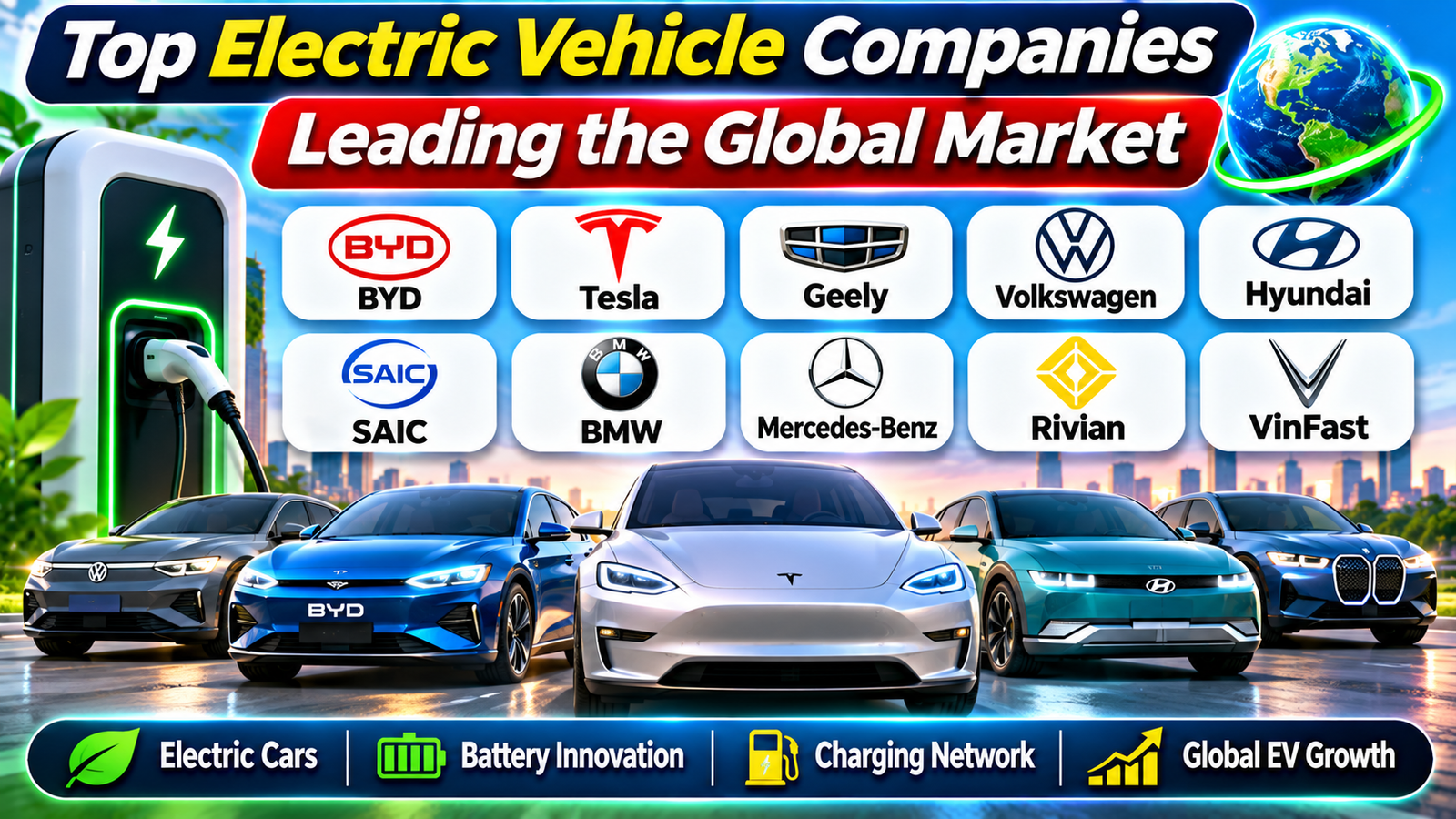
Top 10 Electric Vehicle Companies Leading the Global Market : The electric vehicle (EV) industry is changing the global automotive market. As more consumers explore alternatives to traditional petrol and diesel vehicles, automakers are investing in electric cars, battery technology, charging infrastructure, and smarter vehicle features.
Today, electric vehicles are no longer limited to a small group of specialist manufacturers. Established automotive brands and newer technology-focused companies are competing to develop affordable electric cars, premium SUVs, performance vehicles, and commercial electric transport.
According to the International Energy Agency (IEA), global electric car sales exceeded 20 million in 2025, representing approximately one-quarter of all new cars sold worldwide. China remained the largest market, while Europe also recorded strong growth. These developments show how important electric mobility has become to the automotive industry.
In this article, we explore 10 electric vehicle companies leading the global market, their popular models, technology, and contributions to the development of electric transportation.
Note: This is an overview of influential global EV manufacturers, not a strict ranking by market capitalization or sales. The companies have different business models and sell different combinations of battery-electric vehicles (BEVs), plug-in hybrids (PHEVs), and other electrified vehicles.
1. BYD – A Global Leader in Electric Vehicles
BYD is one of the most influential electric vehicle manufacturers in the world. Headquartered in China, the company produces passenger vehicles, commercial vehicles, batteries, and other energy-related technologies.
BYD has expanded its presence across several international markets by offering electric cars and plug-in hybrid vehicles in different price categories.
Popular BYD models include the Dolphin, Atto 3, Seal, and Sealion series, although model names and availability vary by country.
One of BYD’s major strengths is its involvement in battery development and manufacturing. Its Blade Battery technology is designed around lithium iron phosphate (LFP) chemistry, which is known for its thermal stability and durability characteristics.
BYD’s combination of vehicle production, battery technology, and manufacturing scale has helped it become a major competitor in the global EV industry.
Key strengths:
- Electric cars and plug-in hybrid vehicles
- In-house battery development
- Multiple vehicle price segments
- Expanding international presence
Headquarters: China
2. Tesla – A Major Electric Car and Technology Company
Tesla is an American electric vehicle manufacturer known for its battery-powered cars, charging ecosystem, and software-focused vehicle technology.
The company has played an important role in making modern electric cars more visible to consumers. Its vehicles combine electric powertrains, digital interfaces, driver-assistance features, and software updates.
Popular Tesla models include the Model 3, Model Y, Model S, and Model X. Availability and specifications differ across markets.
Tesla also operates a global Supercharger network, although access and compatibility depend on the vehicle, market, and charging standards.
The company is also involved in battery storage and energy products. Its broader energy business complements its electric vehicle operations.
Tesla reported 1,636,129 vehicle deliveries worldwide in 2025, according to its annual delivery announcement.
Key strengths:
- Battery-electric vehicle technology
- Software and over-the-air updates
- Global charging network
- Battery energy storage products
Headquarters: United States
Official website: https://www.tesla.com/
3. Geely – A Growing Global Automotive Group
Geely is a major Chinese automotive group with several vehicle brands and a growing electric mobility business.
Its automotive portfolio includes Geely, Zeekr, Lynk & Co, and other brands. These businesses serve different customer segments, from mainstream vehicles to premium electric models.
Geely has invested in electric vehicle platforms, battery technology, vehicle software, and intelligent driving systems.
Its electric vehicle portfolio includes models such as the Geely EX5 in selected international markets and premium electric vehicles under the Zeekr brand.
Geely Auto reported 1,687,767 new energy vehicle sales in 2025, an increase of 90% compared with the previous year. Its wider group portfolio also includes electrified vehicles sold through different brands.
The company’s international expansion and broad product range make it an important competitor in the global EV industry.
Key strengths:
- Multiple automotive brands
- Electric and hybrid vehicle platforms
- Battery and vehicle technology development
- Growing international presence
Headquarters: China
4. Volkswagen Group – A Major European EV Manufacturer
Volkswagen Group is one of the world’s largest automotive groups. Its portfolio includes Volkswagen, Audi, Porsche, Škoda, CUPRA, and other brands.
The company has expanded its battery-electric vehicle lineup through dedicated electric platforms and new model launches.
Popular electric models across the group include the Volkswagen ID.4, ID.3, Audi Q4 e-tron, Audi Q6 e-tron, Škoda Enyaq, and Porsche Macan Electric.
Volkswagen Group delivered approximately 983,120 battery-electric vehicles in 2025, representing a 32% increase compared with 2024, according to its annual reporting.
Its broad brand portfolio allows it to compete in several segments, including affordable family cars, premium SUVs, performance vehicles, and commercial transportation.
Key strengths:
- Large international manufacturing network
- Multiple automotive brands
- Wide range of electric vehicle models
- Dedicated electric vehicle platforms
Headquarters: German
5. Hyundai Motor – Innovation in Electric Mobility
Hyundai Motor is a South Korean automotive manufacturer that has expanded its electric vehicle business through dedicated EV models and electrified vehicle technology.
The company’s IONIQ lineup includes vehicles such as the IONIQ 5 and IONIQ 6. These models focus on electric driving range, modern design, digital features, and fast-charging capability.
Hyundai also continues to develop hybrid and other electrified vehicles as part of its broader powertrain strategy.
Its E-GMP electric vehicle platform supports several modern EV models and is designed to accommodate different vehicle types.
Hyundai’s global manufacturing and distribution network helps it compete in markets across North America, Europe, Asia, and other regions.
Key strengths:
- IONIQ electric vehicle lineup
- Dedicated EV platform technology
- Fast-charging capability on supported models
- Global automotive presence
Headquarters: South Korea
6. SAIC Motor – A Major Chinese Electric Vehicle Group
SAIC Motor is a large Chinese automotive manufacturer with several vehicle brands and international partnerships.
Its portfolio includes MG, IM Motors, Roewe, and other automotive businesses. The group produces conventional vehicles as well as battery-electric and plug-in hybrid models.
MG has become particularly visible in international EV markets, offering electric cars such as the MG4 Electric in selected countries.
SAIC’s experience in large-scale vehicle manufacturing, battery-powered models, and international distribution makes it an important player in the global automotive industry.
The company’s electric vehicle business also benefits from its broad manufacturing capabilities and partnerships.
Key strengths:
- Multiple automotive brands
- Electric and plug-in hybrid vehicles
- International vehicle distribution
- Large-scale manufacturing experience
Headquarters: China
7. BMW Group – Premium Electric Vehicle Technology
BMW Group is a German automotive manufacturer known for premium vehicles. It has expanded its electric vehicle range through BMW, MINI, and Rolls-Royce brands.
BMW’s electric lineup includes models such as the BMW i4, i5, i7, and iX, with availability varying by market.
The company focuses on combining electric performance, driving comfort, premium interiors, and advanced vehicle technology.
BMW is also investing in new vehicle architectures, battery development, and software systems to support its future electric models.
Its premium positioning makes the company an important competitor in the luxury electric vehicle market.
Key strengths:
- Premium electric vehicles
- Advanced vehicle engineering
- Luxury and performance models
- Investment in next-generation EV platforms
Headquarters: Germany
8. Mercedes-Benz – Luxury Electric Mobility
Mercedes-Benz is another major German automotive manufacturer developing electric vehicles for premium and luxury customers.
Its electric lineup includes models from the EQ family and newer electric vehicles introduced across different markets.
The company focuses on luxury interiors, advanced safety technology, driving comfort, digital features, and electric powertrain development.
Mercedes-Benz is also working on battery efficiency, vehicle software, and new electric platforms to strengthen its position in the premium EV segment.
Although its electric vehicle strategy competes with brands such as Tesla, BMW, and Audi, Mercedes-Benz places particular emphasis on luxury and premium vehicle experiences.
Key strengths:
- Luxury electric cars and SUVs
- Premium interior design
- Advanced safety and driver-assistance technology
- Electric vehicle platform development
Headquarters: Germany
9. Rivian – An Electric Vehicle Brand Focused on Adventure and Utility
Rivian is an American electric vehicle company that focuses on electric trucks, SUVs, and commercial vehicles.
Its R1T electric pickup truck and R1S electric SUV are designed for customers interested in utility, outdoor activities, and premium electric transportation.
Rivian has also developed electric delivery vehicles for commercial applications. Its partnership with Amazon helped bring electric delivery vans into large-scale business operations.
The company is working to expand its product lineup and manufacturing capabilities while developing vehicle software and electrical architecture.
Rivian’s focus on trucks, SUVs, and commercial electric vehicles gives it a different position from manufacturers that primarily sell passenger sedans.
Key strengths:
- Electric pickup trucks and SUVs
- Commercial electric delivery vehicles
- Software and vehicle technology
- Focus on utility and adventure-oriented transportation
Headquarters: United States
10. VinFast – An Emerging Global EV Manufacturer
VinFast is a Vietnamese automotive manufacturer that has developed a range of electric vehicles and expanded into international markets.
Its electric vehicle lineup includes models such as the VF 6, VF 7, VF 8, and VF 9, depending on regional availability.
The company is working to establish its brand in markets outside Vietnam through vehicle sales, distribution partnerships, and manufacturing investment.
VinFast’s international ambitions make it an interesting company to watch as competition increases among electric vehicle manufacturers.
Like other newer EV brands, its long-term success will depend on product quality, pricing, service networks, customer confidence, and the ability to compete in different markets.
Key strengths:
- Electric SUV lineup
- International expansion plans
- Investment in EV manufacturing
- Focus on developing a global automotive brand
Headquarters: Vietnam
What Is Driving the Growth of the Global EV Industry?
Several factors are influencing the expansion of electric vehicles worldwide.
1. Battery technology: Improvements in battery chemistry, energy density, charging performance, and manufacturing processes are helping manufacturers develop new EV models.
2. Government policies: Incentives, emissions regulations, and investment programs can influence EV adoption. However, policies differ significantly by country and may change over time.
3. Charging infrastructure: Public charging networks and home charging solutions make electric vehicle ownership more practical for many drivers.
4. Consumer demand: More vehicle choices, changing fuel costs, and interest in electric mobility are encouraging some consumers to consider EVs.
5. Automotive competition: Established manufacturers and newer EV companies are competing through pricing, technology, vehicle design, and product availability.
According to the IEA’s Global EV Outlook 2026, global electric car sales exceeded 20 million in 2025, and around one in four new cars sold worldwide was electric. China remained the largest market, accounting for a substantial share of global EV sales.
Conclusion
The global electric vehicle industry is led by a mix of established automotive manufacturers and newer technology-focused companies.
BYD and Tesla are major names in the battery-electric vehicle market, while Geely and SAIC demonstrate the growing influence of Chinese manufacturers. Volkswagen, Hyundai, and BMW continue to expand their electric vehicle portfolios, while Mercedes-Benz focuses on premium electric mobility. Rivian and VinFast represent newer companies developing distinctive products and international ambitions.
There is no single company that leads every part of the EV industry. Some manufacturers have stronger sales volumes, others focus on premium vehicles, and some compete through batteries, software, charging networks, or commercial transportation.
As battery technology develops and more electric models enter the market, competition is likely to remain strong. For consumers, this means more vehicle choices and continued changes in the way cars are designed, manufactured, and powered.
Editorial note: Company model availability, specifications, and sales figures vary by market and reporting method. Check each manufacturer’s official website for the latest local models and specifications before making a purchase decision.
Read More: Apple iPhone Duo Review: Features, Camera, Price and Pros & Cons
1 thought on “Top 10 Electric Vehicle Companies Leading the Global Market”
Comments are closed.