

Introduction
The healthcare industry is one of the largest employment sectors in the United States, offering career opportunities for people with different educational backgrounds and professional skills. Private hospitals, medical clinics, specialist centres, diagnostic laboratories, dental practices, rehabilitation facilities and healthcare companies employ millions of professionals across the country.
For job seekers interested in building a career in the American healthcare sector, private healthcare can offer opportunities in patient care, medical technology, nursing, pharmacy, administration and diagnostic services. Some positions require advanced medical degrees and professional licences, while others may be accessible through shorter training programmes or associate degrees.
According to the U.S. Bureau of Labor Statistics (BLS), healthcare occupations are projected to have approximately 1.9 million job openings per year on average between 2025 and 2035. This includes opportunities created by employment growth and the need to replace workers who leave their occupations.
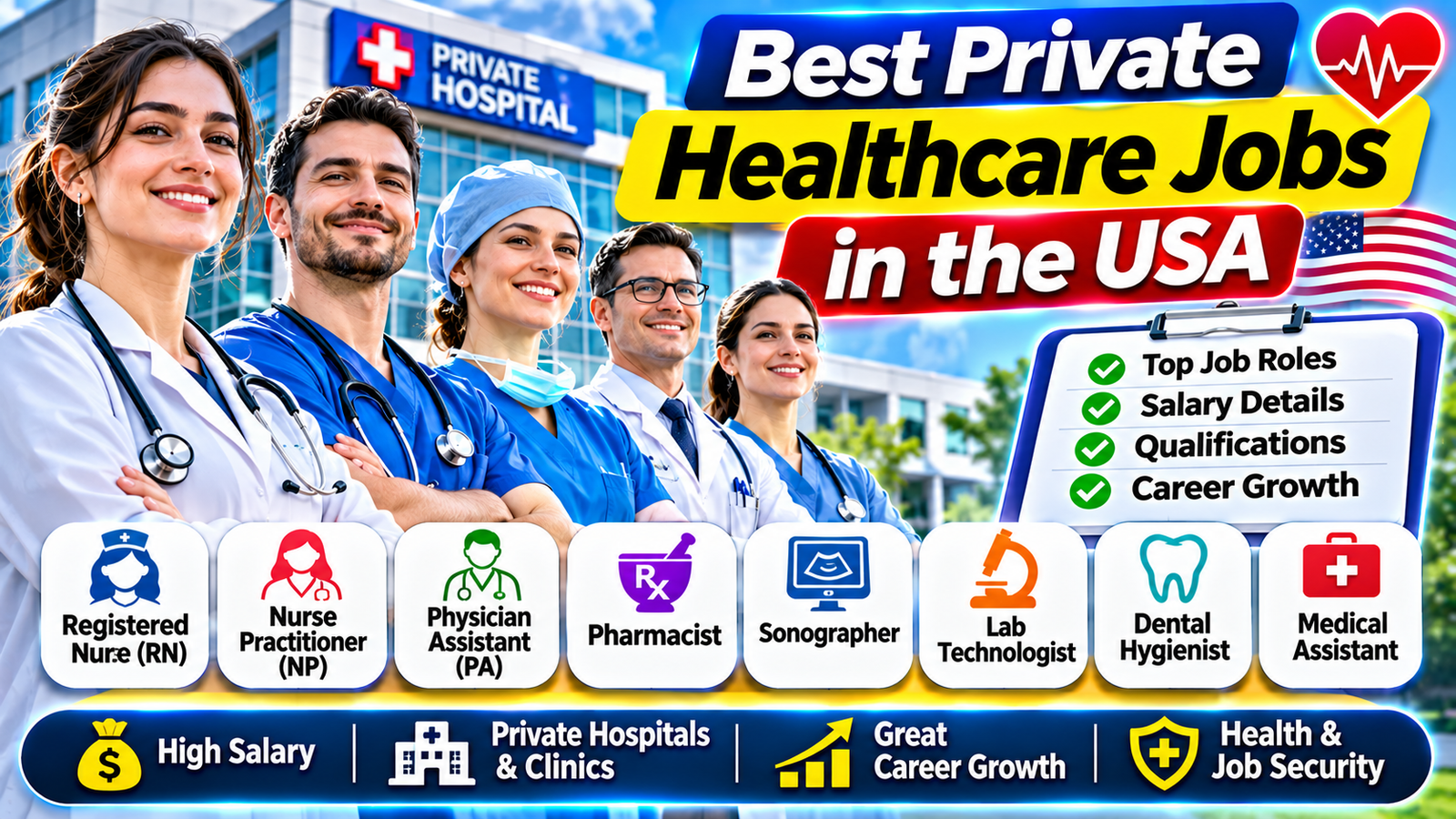
If you are exploring healthcare career options, here are some of the best private healthcare jobs in the USA, along with their responsibilities, estimated salaries and typical education requirements.
1. Registered Nurse (RN)
Registered nurses are among the most important professionals in private hospitals, outpatient clinics, specialist medical centres and healthcare facilities.
Their responsibilities include monitoring patients, administering prescribed medications, maintaining medical records, assisting doctors and educating patients about their health conditions.
Registered nurses may work in emergency departments, intensive care units, operating rooms, maternity departments and other specialist areas.
- 2025 median annual salary: $97,550
- Typical education: Bachelor of Science in Nursing (BSN) or another qualifying nursing pathway
- Career opportunities: Private hospitals, clinics, nursing facilities and outpatient centres
Registered nursing can be a strong career choice for people who enjoy patient care and want opportunities to specialise in different medical fields. Nurses must meet the licensing requirements of the state where they intend to work.
2. Nurse Practitioner (NP)
Nurse practitioners are advanced practice registered nurses who provide a wider range of healthcare services than many traditional nursing roles.
Depending on their state laws and specialisation, they may examine patients, diagnose certain conditions, prescribe medications and develop treatment plans. They often work in primary care, family medicine, women’s health and specialised medical practices.
Private healthcare providers may recruit nurse practitioners to support doctors and improve access to patient services.
- 2025 median annual salary: $134,920
- Typical education: Master’s degree in an advanced nursing programme
- Career opportunities: Private medical practices, hospitals and specialist clinics
This career generally requires substantial education, clinical experience and advanced professional certification. It may be suitable for experienced nurses who want to progress into advanced clinical responsibilities.
3. Physician Assistant (PA)
Physician assistants work with physicians and other healthcare professionals to provide medical services. Their responsibilities may include examining patients, taking medical histories, ordering or interpreting tests and helping develop treatment plans.
They are employed in different settings, including private hospitals, surgical centres, emergency departments and specialist clinics. Their exact responsibilities depend on state regulations and the physician relationship required by law.
- 2025 median annual salary: $135,880
- Typical education: Master’s degree from an accredited physician assistant programme
- Career opportunities: Private hospitals, specialist practices and outpatient clinics
Physician assistant positions can be attractive for people interested in clinical medicine who want to work as part of a medical team. Applicants generally need relevant education, clinical training and state-specific licensure.
4. Pharmacist
Pharmacists are responsible for dispensing prescription medicines and explaining how patients should use them safely. They also check prescriptions, identify possible medication-related problems and provide guidance about drug interactions and side effects.
Private hospitals, retail pharmacy chains, specialist clinics and healthcare organisations employ pharmacists.
- 2025 median annual salary: $140,910
- Typical education: Doctor of Pharmacy (Pharm.D.) degree
- Career opportunities: Hospital pharmacies, retail pharmacies and specialist healthcare services
Pharmacy can be a rewarding career for people interested in medicines, patient safety and healthcare science. In the United States, pharmacists must satisfy the licensing requirements applicable in their state.
5. Diagnostic Medical Sonographer
Diagnostic medical sonographers use ultrasound equipment to create images of internal body structures. Doctors use these images to help evaluate medical conditions and monitor different aspects of patient health.
Sonographers may specialise in areas such as abdominal imaging, obstetrics and gynaecology, cardiac imaging or vascular examinations.
- 2025 median annual salary: $96,590
- Typical education: Associate degree
- Career opportunities: Private diagnostic centres, hospitals and specialist imaging clinics
This role may appeal to people interested in medical technology and patient interaction. Professional certification is often preferred or required by employers, depending on the workplace and state.
6. Radiologic and MRI Technologist
Radiologic technologists perform diagnostic imaging examinations, while MRI technologists operate magnetic resonance imaging equipment. These professionals help doctors obtain images needed to investigate injuries, illnesses and other medical conditions.
They may work in private hospitals, imaging centres, orthopaedic clinics and specialist diagnostic facilities.
- 2025 median annual salary: $81,390
- Typical education: Associate degree
- Career opportunities: Private imaging centres, hospitals and outpatient facilities
People interested in this career should develop technical knowledge, attention to detail and good patient communication skills. Certification and state licensing requirements vary according to the role and location.
7. Clinical Laboratory Technologist
Clinical laboratory technologists perform tests on blood, tissue and other biological samples. Their work helps doctors identify diseases, monitor treatment and make medical decisions.
Private diagnostic laboratories, hospital laboratories, research facilities and specialist healthcare organisations employ laboratory professionals.
- 2025 median annual salary: $62,930
- Typical education: Bachelor’s degree
- Career opportunities: Diagnostic laboratories, private hospitals and medical testing facilities
This career is suitable for people interested in biology, chemistry and laboratory science. Some employers require professional certification, and certain states have additional licensing requirements.
8. Respiratory Therapist
Respiratory therapists help patients who experience breathing difficulties or other problems affecting their respiratory systems. They may work with patients who have asthma, chronic lung conditions or other serious breathing disorders.
Their duties can include providing respiratory treatments, operating breathing equipment, monitoring patient progress and assisting medical teams.
- 2025 median annual salary: $82,280
- Typical education: Associate degree
- Career opportunities: Private hospitals, respiratory clinics and rehabilitation facilities
Respiratory therapy can be a good option for people interested in specialised patient care. Employers generally expect candidates to complete an approved education programme and meet applicable licensing or credential requirements.
9. Dental Hygienist
Dental hygienists work with dentists to help patients maintain good oral health. Their responsibilities commonly include cleaning teeth, examining patients for signs of oral disease, taking dental X-rays when authorised and explaining preventive dental care.
Private dental clinics and dental care groups are important employers in this field.
- 2025 median annual salary: $98,100
- Typical education: Associate degree
- Career opportunities: Private dental practices and specialist dental clinics
Dental hygiene may be an attractive career for people who prefer a focused healthcare role with regular patient interaction. State licensing is generally required before practising.
10. Medical Assistant
Medical assistants support doctors and other healthcare professionals by performing administrative and basic clinical tasks. They may schedule appointments, update patient records, measure vital signs, prepare examination rooms and assist during certain procedures.
Private clinics, family practices, specialist centres and outpatient facilities regularly employ medical assistants.
- 2025 median annual salary: $45,690
- Typical education: Postsecondary nondegree award
- Career opportunities: Private clinics, hospitals and medical offices
This role may be a starting point for people interested in healthcare who do not initially plan to pursue an advanced medical degree. Training and certification preferences vary between employers and states.
11. Health Information Technologist
Healthcare organisations rely on accurate digital records to manage patient information and support medical services. Health information technologists and medical registrars help maintain healthcare information systems and analyse clinical data.
Their work may involve electronic health records, data quality, medical coding systems, privacy procedures and healthcare technology.
- 2025 median annual salary: $68,020
- Typical education: Associate degree
- Career opportunities: Private hospitals, healthcare technology companies and medical record departments
This career may suit people who enjoy technology, organisation and healthcare administration. It can also provide an entry point into the growing area of digital health services.
12. Medical Dosimetrist
Medical dosimetrists work with radiation oncology teams to plan radiation treatments for patients with cancer. They calculate radiation doses and help develop treatment plans under the direction of qualified medical professionals.
They are employed by cancer treatment centres, private hospitals and specialised oncology facilities.
- 2025 median annual salary: $147,470
- Typical education: Bachelor’s degree
- Career opportunities: Private cancer centres, hospitals and radiation oncology departments
This is a specialised career that requires strong technical knowledge, mathematics skills and professional training. Additional certification or specialised education may be expected by employers.
Which Private Healthcare Jobs Are Worth Considering?
The right career depends on your education, interests, professional experience and willingness to complete additional training.
Here is a quick comparison of selected occupations:
| Job | 2025 median annual pay |
|---|---|
| Medical Dosimetrist | $147,470 |
| Pharmacist | $140,910 |
| Physician Assistant | $135,880 |
| Nurse Practitioner | $134,920 |
| Dental Hygienist | $98,100 |
| Registered Nurse | $97,550 |
| Diagnostic Medical Sonographer | $96,590 |
| Respiratory Therapist | $82,280 |
| Radiologic and MRI Technologist | $81,390 |
| Medical Assistant | $45,690 |
These figures are national occupational median wages reported by the BLS. They are not salary guarantees and are not limited to private-sector employers.
How to Find Private Healthcare Jobs in the USA
Job seekers can explore private healthcare vacancies through several online recruitment platforms and employer career pages.
1. Search healthcare job websites: Platforms such as Indeed, LinkedIn Jobs and Glassdoor allow candidates to search for healthcare positions by job title, location and experience level.
2. Visit private hospital career pages: Many private hospital groups and healthcare organisations publish vacancies directly on their official websites.
3. Check your qualifications: Review the education, certification, experience and licensing requirements listed in each job advertisement.
4. Prepare a healthcare-focused resume: Include relevant education, clinical experience, technical skills, certifications and professional achievements.
5. Understand state licensing rules: Healthcare licensing requirements can differ between U.S. states. Confirm the rules with the relevant state licensing board before applying.
Important Information for International Applicants
People applying from outside the United States should understand that getting a healthcare job offer does not automatically provide permission to work in the country.
Internationally educated healthcare professionals may need their qualifications evaluated, complete additional examinations, meet English-language requirements where applicable and obtain approval from the relevant U.S. licensing authority.
For example, internationally educated nurses must follow the applicable state board of nursing requirements. Physicians trained outside the United States have separate examination, certification and residency-related pathways.
Applicants should also check whether an employer is willing and legally able to support an appropriate work-authorisation or immigration process. Visa sponsorship is not guaranteed for every healthcare vacancy.
Conclusion
Private healthcare in the USA offers a wide range of career opportunities, from registered nursing and pharmacy to medical imaging, laboratory science and healthcare technology. Some roles require advanced degrees and professional licences, while others can be entered through shorter training programmes.
Before choosing a career, compare the education requirements, salary information, licensing rules and employment opportunities in your preferred state. Researching these factors can help you identify a healthcare profession that matches your skills and long-term career goals.
Read More: 10 Highest-Paying Government Jobs in the USA: Salary Guide
1 thought on “Best Private Healthcare Jobs in the USA: Salaries & Requirements”
Comments are closed.