

Writing your first resume can feel challenging when you have never had a formal job. You may wonder what to include, how to present your skills and how to convince employers to consider you without previous work experience.
The good news is that you do not need years of employment history to create a professional resume. Your education, projects, internships, volunteer activities, certifications and transferable skills can help demonstrate your potential to an employer.
A resume is not simply a list of previous jobs. It is a short document that explains who you are professionally, what you can offer and why you may be suitable for a particular position.
In this guide, you will learn how to write a professional resume with no experience, choose the right format, highlight your strengths and avoid common mistakes when applying for your first job.
1. Choose the Right Resume Format
The first step is selecting a format that presents your qualifications clearly. For most beginners, a skills-focused or combination resume is a practical choice because it highlights relevant abilities, education and projects instead of relying heavily on employment history.
There are three common resume formats.
Chronological resume: Lists work experience in reverse chronological order, starting with the most recent position. This format is useful when you have relevant employment history.
Functional resume: Emphasizes skills and abilities rather than employment dates. It can be useful in some circumstances, although certain employers may prefer a clearer timeline.
Combination resume: Highlights relevant skills and supporting experience, followed by education, projects or employment history. This can work well for freshers and career changers.
If you are applying for your first job, use a simple layout with clear headings. Avoid complicated designs, excessive graphics and unnecessary columns that may make the document difficult to read.
2. Add Your Contact Information
Your contact information should appear near the top of your resume so employers can easily reach you.
Include:
- Your full name
- A professional email address
- Your phone number with the appropriate country code
- Your city and country, when relevant
- A LinkedIn profile or professional portfolio, if available and relevant
For example:
Rahul Sharma
Bengaluru, India
Email: xxxxxxxxxxxx@email.com
Phone: +91 XXXXX XXXXX
LinkedIn: linkedin.com/in/your-profile
This is an illustrative example, not a real contact profile.
You generally do not need to include your full residential address, identification numbers, bank details or other sensitive personal information.
For international applications, follow the employer’s instructions and local hiring conventions. A photograph, date of birth or other personal details may be unnecessary or inappropriate depending on the country and role.
3. Write a Strong Resume Summary
A resume summary is a short introduction that explains your background, relevant strengths and career objective. It should help an employer quickly understand what you bring to the role.
Keep it concise, usually around two to four sentences, and tailor it to the vacancy.
For example, a fresher applying for an entry-level office position could write:
“Motivated graduate with strong communication, organizational and computer skills. Interested in an entry-level administrative position where I can support daily operations, learn new processes and contribute to team goals. Eager to develop practical experience in a professional environment.”
If you are applying for a technical position, mention relevant technical skills or projects instead.
Avoid generic statements such as “I want a good job in a reputed company.” Focus on what makes you suitable for the position and what you can contribute.
4. Highlight Your Education
When you have limited employment experience, your education can provide important evidence of your knowledge and abilities.
Include your degree or qualification, institution name, graduation year and other details relevant to the job.
For example:
Bachelor of Arts (MBA)
ABC College, Bengaluru
Graduation: 2025
You can also mention relevant coursework, academic achievements, research assignments or projects if they demonstrate skills required for the position.
For technical roles, relevant subjects and practical coursework may be particularly valuable. For administrative positions, communication, research, writing or computer-related coursework may be useful.
Include your grades or percentage if they strengthen your application or the employer specifically requests them. Do not invent qualifications, achievements or academic results.
If you are still studying, state your expected graduation date instead of suggesting that you have already completed the course.
5. Include Relevant Skills
Employers often look for evidence that applicants can perform the responsibilities described in a job advertisement. Even without previous employment, you may already have useful skills from your studies, personal projects or extracurricular activities.
Skills generally fall into two categories.
Technical or hard skills are specific abilities that can be demonstrated, such as:
- Microsoft Word and Excel
- Google Docs and Google Sheets
- Data entry and document preparation
- Basic graphic design
- Programming fundamentals
- Research and data analysis
- Social media content creation
Soft skills relate to how you work with other people and manage responsibilities. Examples include communication, teamwork, problem-solving, organization and time management.
Choose skills that match the position. For example, an entry-level data entry applicant may emphasize typing accuracy, spreadsheet knowledge and attention to detail.
Do not list every skill you can think of. Include those you can honestly demonstrate and provide examples where possible.
6. Add Projects, Internships and Volunteer Experience
One of the most effective ways to strengthen a resume without formal employment is to demonstrate what you have actually done.
Relevant experience does not always have to come from a paid job. Academic projects, internships, volunteering, student activities and personal projects can all provide evidence of your abilities.
For example, if you created a website, you could describe the tools you used, the pages you developed and the responsibilities you handled.
A resume entry might look like this:
Personal Website Project
- Created a basic website to publish and organize informational articles.
- Practised content writing, page formatting and website management.
- Learned to organize information for a specific audience.
Use this example only if it reflects your actual experience. Replace it with your own project and results.
If you completed an internship, mention the organization, dates, responsibilities and skills gained. For volunteer work, describe your contribution rather than simply listing the activity.
These examples help employers evaluate your practical abilities even when you have not held a formal position.
7. Include Relevant Courses and Certifications
Short courses and certifications can strengthen your resume when they relate directly to the job.
For example, an applicant seeking an entry-level digital marketing role might include a relevant course in digital marketing, analytics or content creation.
Someone applying for an administrative position could list training in spreadsheets, office applications or professional communication.
Include the course name, issuing organization and completion date when useful. If a certification is still in progress, label it accurately.
Free learning resources can help you build skills, but completing a course does not automatically make you an expert. Be prepared to explain what you learned and how you have applied it.
Prioritize relevant training instead of filling your resume with unrelated certificates.
8. Make Your Resume ATS-Friendly
Some employers use applicant tracking systems (ATS) to organize applications and help identify resumes that match job requirements.
An ATS-friendly resume should be easy for both software and people to read.
Follow these practical tips:
- Use standard headings such as “Education,” “Skills,” “Projects” and “Experience.”
- Choose a readable font and consistent formatting.
- Include relevant keywords from the job description when they accurately describe your qualifications.
- Avoid unnecessary graphics, icons and complex layouts.
- Follow the requested file format and naming instructions.
- Proofread the document before submitting it.
For example, if a job advertisement asks for Excel, data entry and attention to detail, include those terms if you genuinely have those skills.
Do not copy an entire job description into your resume or claim experience you do not possess. An ATS-friendly format may improve readability, but it cannot guarantee that your application will be shortlisted.
9. Avoid Common Resume Mistakes
A resume can lose impact when it contains irrelevant information, spelling errors or unsupported claims.
Avoid these common mistakes:
Using the same resume for every job: Tailor your summary and relevant skills to each position.
Making the document unnecessarily long: For most entry-level applicants, one well-organized page is a sensible target. Add more only when your relevant experience justifies it.
Inventing experience: Never claim to have worked for a company, completed a certification or achieved a result if it is not true.
Using an unprofessional email address: Create a simple email address based on your name where possible.
Adding unrelated personal details: Keep the resume focused on qualifications and job suitability.
Ignoring instructions: If an employer requests a particular subject line, file format or supporting document, follow the instructions carefully.
Submitting without proofreading: Check spelling, dates, contact information, formatting and consistency before sending your application.
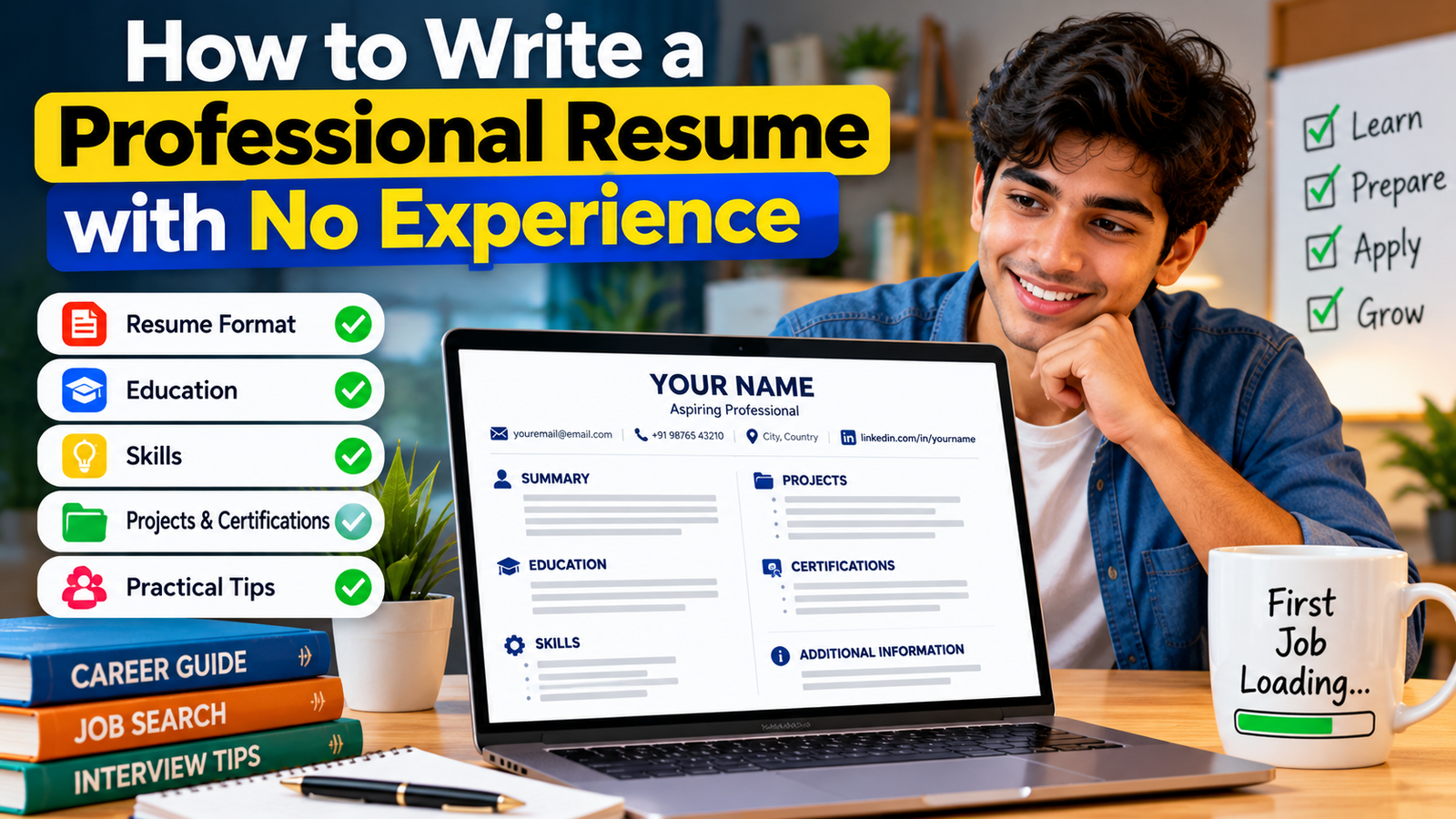
10. Simple Resume Structure for Freshers
You can use the following structure as a starting point for your first resume:
- Full name and contact information
- Professional summary
- Relevant skills
- Education
- Projects, internships or volunteer experience
- Relevant certifications
- Additional information directly related to the job
The order can change depending on your strongest qualifications and the role. For example, a candidate with a relevant technical project may place projects above education, while a recent graduate may lead with academic qualifications.
For additional guidance, you can explore career resources provided by your country’s official employment services or review their resume-writing guidelines.
Final Thoughts
Writing a professional resume with no experience is about showing employers what you can offer, not apologizing for what you have not done yet.
Start with a clear format, add accurate contact information and write a summary tailored to your target position. Highlight your education, relevant skills, projects, internships and certifications. Make the document easy to read, use relevant keywords naturally and check every detail before submitting it.
Remember that your first resume does not need to be perfect. Update it as you complete new projects, develop skills and gain experience.
With a focused resume and consistent applications, you can present your potential professionally and take a confident first step toward your career.
Read More : How to Find Jobs Abroad from Your Home Country: A Step-by-Step Guide
1 thought on “How to Write a Professional Resume with No Experience: A Beginner’s Guide”
Comments are closed.