

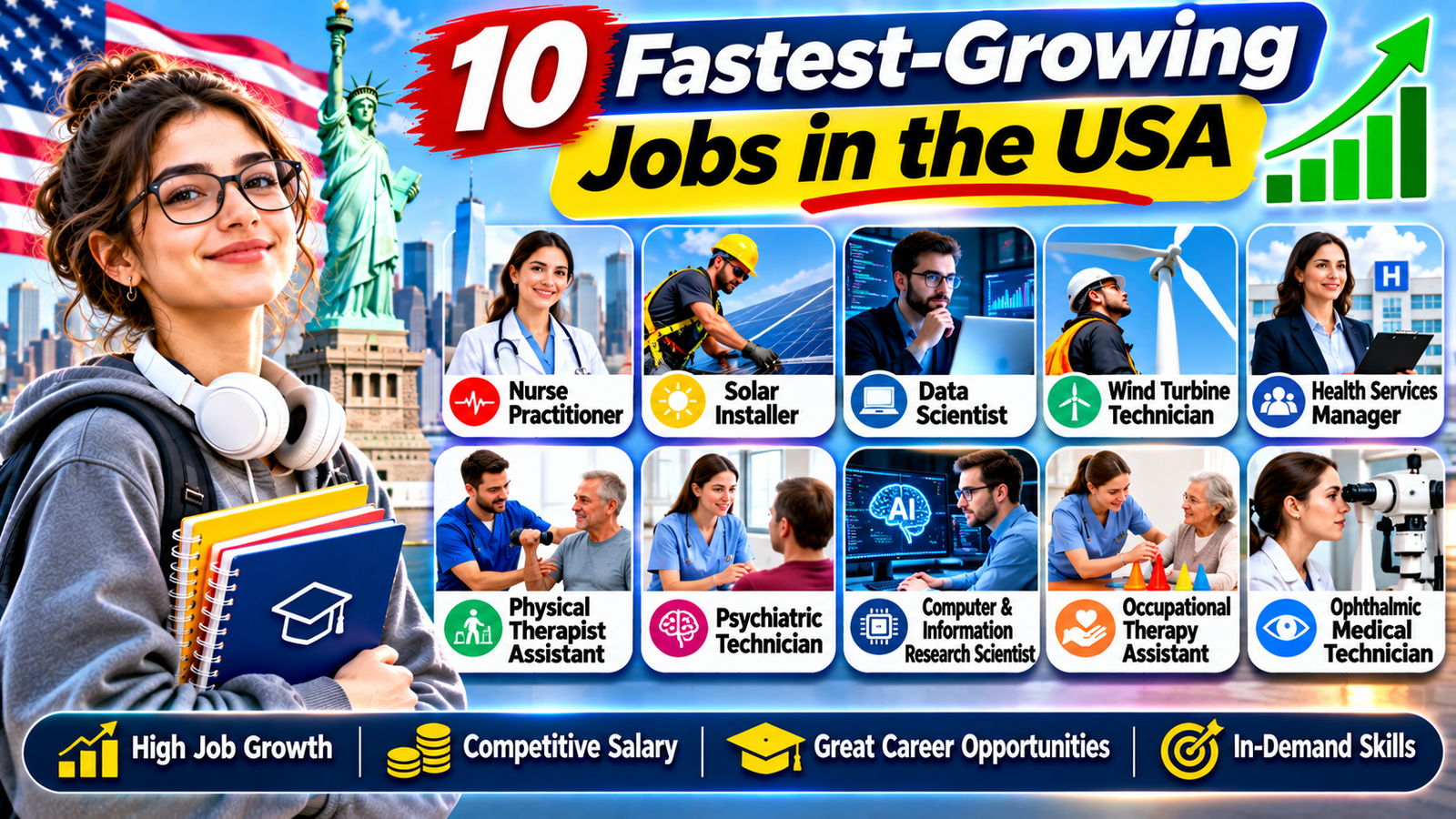
10 Fastest-Growing Jobs in the USA: Careers to Watch: Choosing the right career is an important decision, especially in a changing job market. Technology, healthcare needs, renewable energy, and an aging population are influencing the types of workers American employers may need over the coming years.
For students, recent graduates, experienced professionals, and people considering a career change, understanding employment trends can help identify promising career paths.
According to the U.S. Bureau of Labor Statistics (BLS), the latest 2025–2035 employment projections identify several occupations expected to grow much faster than the average across all jobs. Healthcare, clean energy, and technology feature prominently in the rankings.
In this guide, we explore 10 of the fastest-growing jobs in the USA, including projected employment growth, 2025 median annual pay, typical education requirements, and the skills that can help candidates prepare.
The figures below are national U.S. projections, not guarantees of future vacancies or individual salaries.
1. Nurse Practitioners
Projected job growth (2025–2035): 41.0%
2025 median annual pay: $132,300
Typical education: Master’s degree
Nurse practitioners are advanced practice registered nurses who provide healthcare services to patients. Their responsibilities can include examining patients, diagnosing certain health conditions, ordering tests, managing treatment plans, and providing preventive healthcare.
The BLS projects nurse practitioners to have the fastest employment growth among detailed occupations in the United States between 2025 and 2035.
Growing healthcare needs, an aging population, and demand for accessible medical services are important factors supporting this career.
To enter this profession, candidates generally need to become registered nurses, gain relevant experience, complete an approved graduate-level nurse practitioner program, and meet state licensing and certification requirements.
Useful skills: Patient communication, clinical assessment, critical thinking, medical knowledge, and decision-making.
Best suited for: People interested in healthcare who are prepared for advanced education and professional licensing.
2. Solar Photovoltaic Installers
Projected job growth: 36.5%
2025 median annual pay: $53,140
Typical education: High school diploma or equivalent
Solar photovoltaic installers, often called solar panel installers, assemble, install, and maintain solar energy systems.
Their work may involve preparing rooftops or other installation areas, mounting solar panels, connecting electrical components, and checking whether systems operate correctly.
The growing use of solar power and investment in renewable electricity are contributing to demand for workers in this field.
Many people enter the occupation with a high school diploma and receive on-the-job training. Some employers may prefer candidates with electrical or construction experience, technical training, or relevant certifications.
The job can involve outdoor work, physical activity, working at heights, and following electrical and workplace safety procedures.
Useful skills: Electrical knowledge, mechanical ability, attention to detail, problem-solving, and safety awareness.
Best suited for: People who enjoy practical technical work and renewable energy.
3. Data Scientists
Projected job growth: 34.6%
2025 median annual pay: $120,230
Typical education: Bachelor’s degree
Data scientists analyze large amounts of information to identify patterns, answer business questions, and support decision-making.
Organizations in finance, healthcare, retail, technology, manufacturing, and other industries use data to understand customers, improve operations, manage risks, and develop products.
Data scientists may collect and clean data, build statistical models, create visualizations, and communicate findings to business teams.
Demand for data analysis, artificial intelligence, and data-driven decision-making is expected to support employment growth in this occupation.
A bachelor’s degree in data science, statistics, mathematics, computer science, or a related subject is a common starting point. Some advanced roles may require a master’s degree or specialized experience.
Useful skills: Python, SQL, statistics, machine learning, data visualization, and analytical thinking.
Best suited for: People who enjoy mathematics, programming, research, and solving problems using data.
4. Wind Turbine Service Technicians
Projected job growth: 29.5%
2025 median annual pay: $64,120
Typical education: Postsecondary nondegree award
Wind turbine service technicians install, inspect, maintain, and repair wind turbines. They help ensure that wind energy equipment operates safely and efficiently.
Their responsibilities may include checking mechanical and electrical systems, identifying faults, replacing damaged components, and performing routine maintenance.
As wind power infrastructure develops, employers are expected to need technicians who can maintain and repair these systems.
Candidates commonly complete technical training through a postsecondary program, followed by practical training and employer-specific instruction.
The occupation can require climbing tall structures, working outdoors, handling equipment, and following strict safety procedures.
Useful skills: Mechanical knowledge, electrical troubleshooting, physical fitness, attention to detail, and safety awareness.
Best suited for: People interested in mechanical systems, electrical work, and renewable energy technology.
5. Medical and Health Services Managers
Projected job growth: 24.2%
2025 median annual pay: $123,860
Typical education: Bachelor’s degree
Medical and health services managers, also known as healthcare administrators or healthcare executives, coordinate the business and administrative operations of healthcare organizations.
They may manage hospital departments, medical practices, nursing facilities, or other healthcare services.
Typical responsibilities include managing budgets, coordinating staff, monitoring performance, maintaining records, and helping organizations follow healthcare regulations.
The increasing demand for healthcare services is expected to support employment growth in this profession.
A bachelor’s degree in healthcare administration, business administration, public health, or a related field is a common entry route. Some employers prefer candidates with a master’s degree or previous healthcare management experience.
Useful skills: Leadership, communication, budgeting, organization, problem-solving, and knowledge of healthcare regulations.
Best suited for: People who want to combine management, business, and healthcare.
6. Physical Therapist Assistants
Projected job growth: 23.0%
2025 median annual pay: $68,380
Typical education: Associate’s degree
Physical therapist assistants work under the direction and supervision of physical therapists to help patients with rehabilitation and recovery.
They may assist patients with prescribed exercises, help them use rehabilitation equipment, monitor progress, and report observations to the supervising physical therapist.
Patients may need physical therapy after injuries, surgeries, illnesses, or conditions that affect movement and physical function.
Demand for rehabilitation services is expected to support employment growth in this occupation.
In the United States, physical therapist assistants generally complete an accredited associate degree program and meet applicable state licensing or certification requirements.
Useful skills: Patient care, communication, physical stamina, teamwork, and knowledge of rehabilitation exercises.
Best suited for: People interested in healthcare and helping patients improve mobility and physical function.
7. Psychiatric Technicians
Projected job growth: 22.3%
2025 median annual pay: $45,130
Typical education: Postsecondary nondegree award
Psychiatric technicians support the care of people experiencing mental health conditions or developmental disabilities.
They may work in psychiatric hospitals, residential facilities, or other healthcare settings. Their responsibilities can include observing patients, supporting daily activities, recording behavior, assisting with treatment plans, and communicating concerns to healthcare professionals.
Growing demand for mental health and behavioral healthcare services is one factor supporting this career outlook.
Education and training requirements vary by state and employer. Some positions require a postsecondary certificate or other formal training, while certain employers may provide additional workplace instruction.
Useful skills: Patience, communication, observation, empathy, teamwork, and the ability to follow care procedures.
Best suited for: People interested in mental health support and direct patient care.
8. Computer and Information Research Scientists
Projected job growth: 21.8%
2025 median annual pay: $140,300
Typical education: Master’s degree
Computer and information research scientists explore advanced computing technologies and develop new approaches to solve complex problems.
Their work may involve artificial intelligence, machine learning, algorithms, robotics, computing systems, and other areas of computer science.
They may work in research laboratories, universities, government organizations, and private technology companies.
The growing use of AI, digital systems, and advanced computing is expected to contribute to demand for professionals in this occupation.
A master’s degree in computer science or a closely related field is typical for entry. Some research positions may require a doctoral degree or specialized experience.
Useful skills: Advanced programming, mathematics, research, algorithm development, analytical thinking, and technical communication.
Best suited for: People interested in advanced computing, scientific research, and developing new technology.
9. Occupational Therapy Assistants
Projected job growth: 21.5%
2025 median annual pay: $72,300
Typical education: Associate’s degree
Occupational therapy assistants work under the supervision of occupational therapists to help patients develop, recover, or maintain skills needed for everyday activities.
They may assist patients with exercises and activities related to dressing, eating, movement, coordination, and other daily tasks.
Their work can support people recovering from injuries, managing disabilities, or adapting to physical and developmental challenges.
An aging population and demand for rehabilitation services are among the factors supporting this occupation’s projected growth.
In general, candidates need an accredited associate degree and must meet applicable state licensing or certification requirements.
Useful skills: Communication, patience, observation, teamwork, and an interest in rehabilitation.
Best suited for: People who want a practical healthcare career focused on helping patients become more independent.
10. Ophthalmic Medical Technicians
Projected job growth: 21.4%
2025 median annual pay: $45,570
Typical education: Varies by employer and training pathway
Ophthalmic medical technicians assist eye-care professionals with examinations and patient care.
They may prepare patients for eye examinations, collect medical histories, perform selected diagnostic tests, maintain equipment, and help ophthalmologists or other eye-care professionals during clinical procedures.
Demand for eye-care services is expected to support employment opportunities in this field.
Training requirements can vary by employer. Some candidates enter through on-the-job training, while others pursue relevant educational programs or professional certification.
Useful skills: Attention to detail, patient communication, basic medical knowledge, equipment handling, and organization.
Best suited for: People interested in healthcare technology and eye-care services.
How to Prepare for These Fast-Growing Careers
Knowing which occupations are expected to grow is only the first step. Candidates also need to understand the qualifications, training, and experience required for their preferred career.
Here are some practical steps:
- Choose a career direction: Decide whether your interests are in healthcare, technology, renewable energy, or research.
- Research education requirements: Check whether the occupation requires a high school diploma, associate degree, bachelor’s degree, master’s degree, or professional certification.
- Develop relevant skills: Build technical, communication, analytical, or patient-care skills according to your chosen field.
- Gain practical experience: Look for internships, supervised training, apprenticeships, or entry-level opportunities where appropriate.
- Check licensing rules: Healthcare and technical occupations may have state-specific requirements.
- Prepare a professional resume: Highlight relevant education, training, skills, and practical experience.
- Use reliable job websites: Explore employer career pages, state workforce resources, and established job platforms.
For official career information, use the U.S. Bureau of Labor Statistics Occupational Outlook Handbook at https://www.bls.gov/ooh/.
Conclusion
The U.S. job market is expected to create opportunities across healthcare, renewable energy, and technology over the 2025–2035 period.
Nurse practitioners, solar photovoltaic installers, data scientists, and wind turbine service technicians are among the occupations with particularly strong projected growth. Healthcare management, rehabilitation, mental health support, and advanced computing also offer promising career paths.
However, a high growth rate does not automatically mean that a job is easy to obtain or suitable for everyone. Education costs, professional licensing, experience, location, and work authorization can all influence career decisions.
Before choosing a profession, compare its projected growth, median pay, training requirements, and daily responsibilities. Use official BLS information and employer websites to make an informed decision about your future career.
Source note: Employment growth rates and median annual wages in this article are based on the U.S. Bureau of Labor Statistics’ 2025–2035 projections and 2025 wage data. Projections describe expected long-term trends under stated assumptions; actual employment outcomes may differ.
Read More: How to Find Government Jobs in the USA: Complete Guide
1 thought on “10 Fastest-Growing Jobs in the USA: Careers to Watch”
Comments are closed.