

Technology is changing how businesses operate, how people communicate, and how professionals perform their jobs. From artificial intelligence and cloud computing to online marketing and data analytics, digital tools are becoming part of everyday work across many industries.
As a result, learning digital skills can help students, fresh graduates, working professionals, and people planning a career change prepare for new opportunities. You do not necessarily need an engineering degree or advanced technical knowledge to begin. Many digital skills can be learned through online courses, practical projects, and regular practice.
However, choosing the right skill can be confusing because there are so many options available. Some skills involve programming and technical problem-solving, while others focus on creativity, communication, business, and digital platforms.
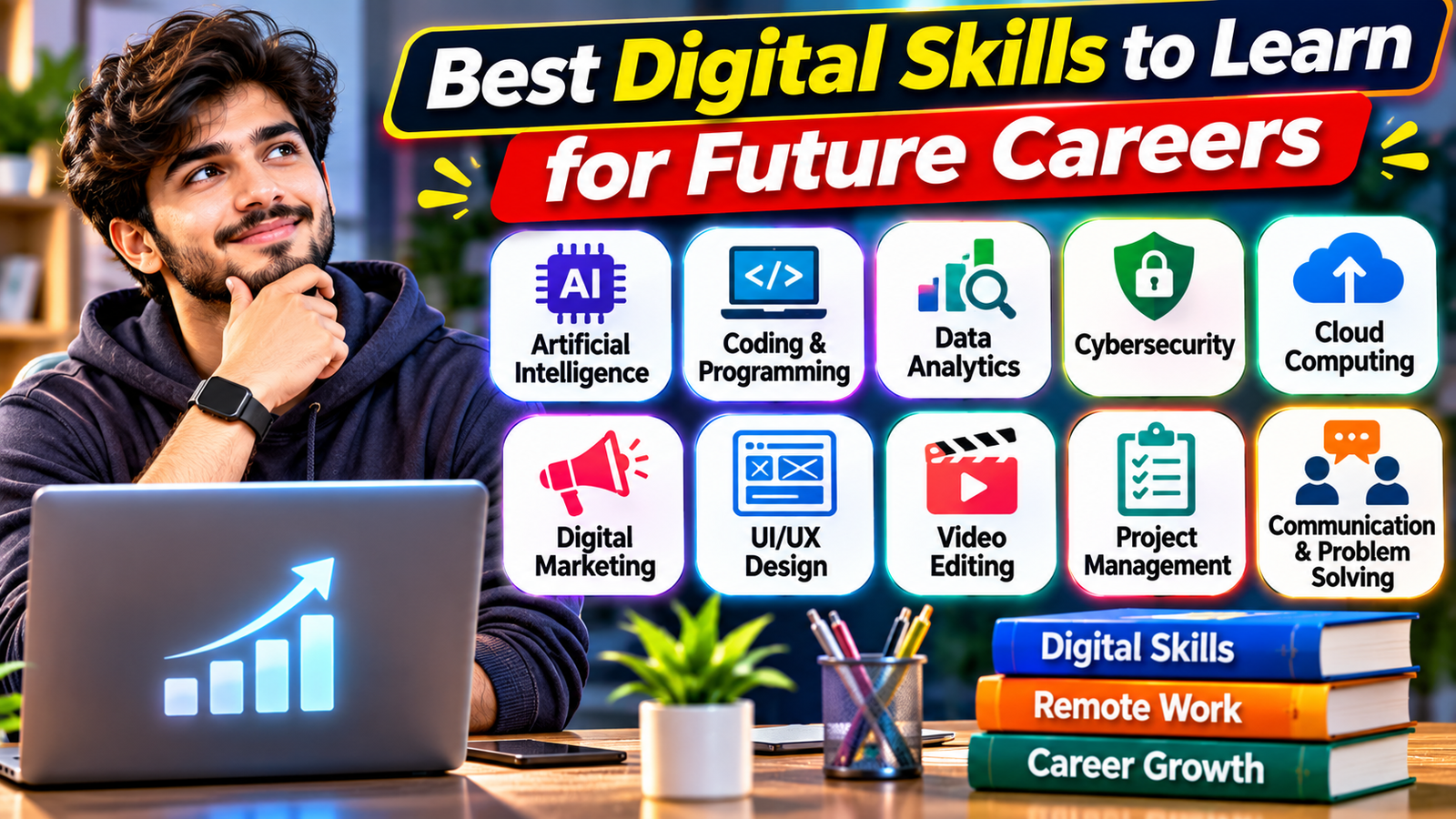
In this guide, we explore 10 useful digital skills to learn for future careers, explain where they are used, and share how beginners can start developing them.
1. Artificial Intelligence and AI Tool Skills
Artificial intelligence is becoming increasingly common in business, education, software development, customer service, and content creation.
Learning how to use AI tools effectively can help professionals complete certain tasks more efficiently. Examples include generating ideas, summarising information, analysing documents, preparing presentations, and assisting with research.
However, knowing how to open an AI application is not enough. It is important to understand how to give clear instructions, evaluate the results, identify mistakes, and use AI responsibly.
Skills to learn:
- AI tool usage and prompt writing.
- Understanding AI-generated content.
- AI-assisted research and productivity.
- Basic knowledge of machine learning concepts.
- Responsible and ethical AI usage.
How to get started: Explore beginner-friendly tools such as ChatGPT, Google Gemini, and Microsoft Copilot. Practise using them for everyday tasks and learn to verify their answers.
Career relevance: Digital marketing, content creation, business operations, software development, and research.
2. Data Analytics
Businesses collect information from customers, websites, sales, applications, and other sources. Data analytics helps organisations understand this information and make informed decisions.
A data analyst may examine datasets, identify patterns, prepare reports, and communicate findings to a business team.
You do not need to become an advanced programmer immediately. Beginners can start with spreadsheets before moving towards more specialised tools.
Skills to learn:
- Microsoft Excel or Google Sheets.
- Data cleaning and organisation.
- Basic statistics.
- Data visualisation.
- SQL fundamentals.
- Power BI or Tableau.
How to get started: Learn spreadsheet formulas, sorting, filtering, and charts. Then practise analysing simple datasets and creating reports.
Career relevance: Data analyst, business analyst, reporting analyst, and operations analyst.
3. Coding and Programming
Programming is the process of writing instructions that computers can understand and execute. It is used to develop websites, mobile applications, software, automation systems, and many other digital products.
Learning to code can help you understand how technology works and build practical projects.
Beginners should avoid trying to learn several programming languages simultaneously. Start with one language based on your interests.
Skills to learn:
- Python for general programming and automation.
- HTML and CSS for website structure and design.
- JavaScript for interactive web development.
- Programming logic and problem-solving.
- Basic debugging and testing.
How to get started: Choose one beginner-friendly language, follow a structured course, and build small projects such as a calculator, personal website, or simple task manager.
Career relevance: Software developer, web developer, automation developer, and junior programmer.
4. Cybersecurity
As organisations depend more heavily on digital systems, protecting information and computer networks has become an important responsibility.
Cybersecurity involves identifying security risks, protecting systems, monitoring suspicious activity, and responding to potential incidents.
It is a broad field, so beginners should first understand basic computer networks, operating systems, and online security principles.
Skills to learn:
- Network fundamentals.
- Operating system basics.
- Password and account security.
- Security monitoring concepts.
- Understanding common cyber threats.
- Basic risk assessment.
How to get started: Learn networking fundamentals and practise in legal cybersecurity training environments. Never test security systems without permission.
Career relevance: Security analyst, security operations centre (SOC) analyst, IT security support, and risk assessment roles.
5. Cloud Computing
Cloud computing allows individuals and organisations to access computing resources such as storage, databases, servers, and software over the internet.
Instead of managing every physical server themselves, businesses can use cloud platforms to support applications and digital services.
Cloud knowledge is useful in areas such as software development, IT operations, infrastructure management, and data services.
Skills to learn:
- Cloud computing fundamentals.
- Virtual machines and storage.
- Networking basics.
- Cloud security concepts.
- Deployment and monitoring.
- Basic knowledge of cloud platforms.
How to get started: Explore introductory learning resources from Amazon Web Services (AWS), Microsoft Azure, and Google Cloud. Understand the basic concepts before moving to advanced services.
Career relevance: Cloud support associate, cloud administrator, cloud engineer, and infrastructure specialist.
6. Digital Marketing
Digital marketing involves promoting products, services, and brands through online channels. Businesses use digital marketing to reach customers, communicate with audiences, and measure campaign performance.
This field combines creativity, communication, research, and data analysis. It can be a suitable option for people who enjoy content creation and understanding consumer behaviour.
Skills to learn:
- Search engine optimisation (SEO).
- Social media marketing.
- Content marketing.
- Email marketing.
- Paid advertising fundamentals.
- Website and campaign analytics.
How to get started: Learn the basics of SEO, create a simple website or practice campaign, and understand how to measure performance using analytics tools.
Career relevance: SEO executive, digital marketing specialist, social media manager, content marketer, and performance marketing assistant.
7. UI and UX Design
User interface (UI) and user experience (UX) design focus on how people interact with websites, mobile applications, and digital products.
UI design is concerned with visual elements such as buttons, colours, typography, and layouts. UX design focuses on the overall experience, including navigation, usability, and solving user problems.
These skills are useful for creating digital products that are easy to understand and use.
Skills to learn:
- Design principles and typography.
- Wireframing and prototyping.
- User research fundamentals.
- Usability testing.
- Responsive design concepts.
- Design tools such as Figma.
How to get started: Learn basic design principles and practise creating simple mobile app screens or website layouts. Build a portfolio that explains the problems your designs aim to solve.
Career relevance: UI designer, UX designer, product designer, and design assistant.
8. Video Editing and Content Creation
Video has become an important format for communication, education, entertainment, and marketing.
Businesses, creators, educational organisations, and media companies use videos to explain ideas, promote products, and connect with audiences.
Learning video editing can help you develop creative skills and explore opportunities in the digital content industry.
Skills to learn:
- Video cutting and trimming.
- Audio editing.
- Transitions and visual effects.
- Subtitles and captions.
- Basic colour correction.
- Short-form and long-form video production.
How to get started: Practise with beginner-friendly tools such as CapCut, DaVinci Resolve, or other suitable editing applications. Create sample videos and gradually improve your editing style.
Career relevance: Video editor, content creator, social media video specialist, and multimedia assistant.
9. Project Management and Digital Collaboration
Digital projects often involve people working from different locations and departments. Project management helps teams organise tasks, manage deadlines, communicate clearly, and track progress.
Even professionals who are not project managers can benefit from understanding how projects are planned and delivered.
Skills to learn:
- Task planning and prioritisation.
- Time management.
- Team communication.
- Project documentation.
- Risk and deadline management.
- Digital collaboration tools.
How to get started: Practise organising a small project using tools such as Trello, Asana, or Microsoft Planner. Learn how to divide work into manageable tasks and monitor progress.
Career relevance: Project coordinator, project assistant, operations coordinator, and team support roles.
10. Communication and Digital Problem-Solving
Technical knowledge is important, but professionals also need to explain ideas, work with others, and solve problems.
Communication and digital problem-solving are useful across almost every industry. Remote and hybrid workplaces make these abilities particularly valuable because teams often depend on written messages, online meetings, and digital documentation.
Skills to learn:
- Professional email writing.
- Clear written and verbal communication.
- Presentation skills.
- Critical thinking.
- Research and information verification.
- Online collaboration and teamwork.
How to get started: Practise writing professional emails, preparing short presentations, explaining technical topics in simple language, and working on small group projects.
Career relevance: Almost every professional field, including technology, business, education, marketing, and customer support.
Which Digital Skill Should Beginners Learn First?
The right choice depends on your interests, existing abilities, and career goals. You do not need to learn all 10 skills at once.
| Your interest | Skills to explore |
|---|---|
| Technology and software | Coding and AI tools |
| Numbers and research | Data analytics |
| Online safety | Cybersecurity |
| IT infrastructure | Cloud computing |
| Business promotion | Digital marketing |
| Creativity and design | UI/UX and video editing |
| Organising teams | Project management |
| Working with people | Communication |
Before selecting a course, check its syllabus, practical exercises, instructor background, and learning requirements.
A Simple 30-Day Plan to Start Learning Digital Skills
If you are unsure where to begin, follow this basic learning plan.
Week 1: Explore your options
Research different digital careers and choose one skill that matches your interests. Understand what beginners need to learn for that field.
Week 2: Learn the fundamentals
Start a beginner-friendly course and study the basic concepts. Avoid jumping between too many unrelated tutorials.
Week 3: Practise with small projects
Apply what you have learned. For example, create a simple website, prepare a spreadsheet report, design a social media post, or edit a short video.
Week 4: Build a portfolio
Collect your practice projects and organise them into a simple portfolio. Review your work, identify areas for improvement, and explore entry-level job requirements.
This is a starting plan rather than a guarantee of job readiness. Some technical careers require months or years of structured learning and practice.
Conclusion
Digital skills can help people prepare for changing career opportunities across technology, business, education, marketing, and other industries.
Artificial intelligence, data analytics, programming, cybersecurity, cloud computing, digital marketing, UI/UX design, video editing, project management, and communication are all useful areas to explore.
The best approach is to choose one skill, learn its fundamentals, and practise through real projects. You can gradually add related skills as your knowledge and experience grow.
You do not need to become an expert overnight. Consistent learning, practical experience, and a willingness to adapt can help you build a stronger foundation for your future career.
Read More: How to Start Working Remotely as a Beginner: A Complete Guide
1 thought on “Best Digital Skills to Learn for Future Careers: 10 Skills to Build”
Comments are closed.