

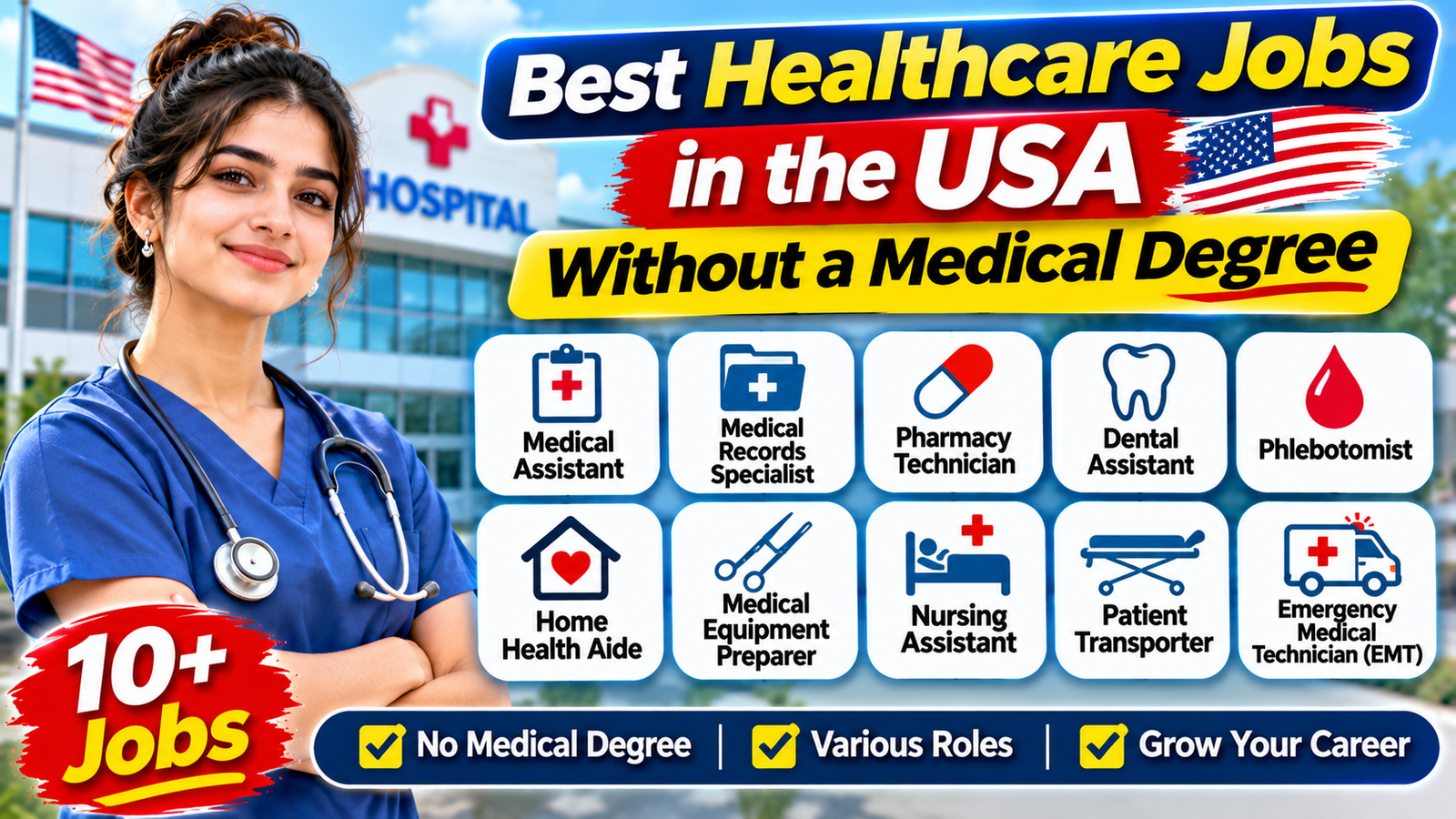
Best Healthcare Jobs in the USA Without a Medical Degree: Working in the healthcare industry does not always require becoming a doctor or earning a medical degree. Hospitals, clinics, dental offices, pharmacies, rehabilitation centres, and home healthcare organisations employ professionals in many different roles.
Some healthcare positions require specialised college degrees, but others are accessible through a high school diploma, short-term training, professional certification, or on-the-job experience.
This creates opportunities for people who want to build a career in healthcare without spending several years in medical school. Students, fresh graduates, and career changers can explore entry-level positions and gradually develop their professional skills.
If you are interested in working in the American healthcare industry, this guide explains 10 healthcare jobs in the USA that do not typically require a medical degree, their responsibilities, education requirements, and potential career paths.
1. Medical Assistant
Medical assistants support doctors and other healthcare professionals in clinics, physician offices, and outpatient facilities.
Their responsibilities can include both administrative and basic clinical tasks. Depending on their training and state regulations, they may measure patients’ vital signs, prepare examination rooms, update medical records, and help schedule appointments.
Typical responsibilities:
- Record patients’ basic health information.
- Measure blood pressure and vital signs.
- Prepare examination rooms.
- Schedule appointments.
- Update patient records.
- Assist healthcare professionals with routine tasks.
Education requirements: Many employers prefer candidates who complete a postsecondary medical assisting programme. Some employers may provide on-the-job training. Certification may improve employment opportunities, although requirements vary.
Best for: People interested in patient care and healthcare administration.
According to the U.S. Bureau of Labor Statistics (BLS), medical assistants typically need a postsecondary nondegree award for entry, rather than a medical degree. <Cite refs={[“turn536743search0″,”turn536743search3”]}/>
2. Medical Records Specialist
Medical records specialists help healthcare organisations manage patient information. They work with electronic health records, medical documentation, and administrative information.
This role is suitable for people who prefer computer-based work rather than direct patient care.
Typical responsibilities:
- Organise and maintain patient records.
- Review medical documents for accuracy.
- Update electronic health information.
- Protect confidential patient information.
- Assist with medical record coding and documentation.
Education requirements: A postsecondary certificate in health information technology or a related subject is commonly required. Some positions may prefer additional training or professional certification.
Best for: People with computer skills, attention to detail, and an interest in healthcare administration.
The BLS identifies medical records specialist as an occupation that typically requires a postsecondary nondegree award rather than a bachelor’s or medical degree. <Cite refs={[“turn536743search0″,”turn536743search3”]}/>
3. Pharmacy Technician
Pharmacy technicians work under the supervision of licensed pharmacists in retail pharmacies, hospitals, and other healthcare settings.
They help with prescription processing, customer service, inventory management, and other pharmacy-related tasks. Their responsibilities depend on state regulations and the employer.
Typical responsibilities:
- Receive prescription information.
- Prepare and label medication orders under supervision.
- Organise pharmacy inventory.
- Process customer payments.
- Maintain prescription-related records.
- Assist pharmacists with routine administrative duties.
Education requirements: A high school diploma or equivalent is commonly required. Some employers provide on-the-job training, while others prefer candidates who complete a pharmacy technician programme or obtain certification.
State registration, examinations, or other requirements may apply.
Best for: People interested in medicines, organisation, and customer service.
Check the pharmacy board requirements in the state where you plan to work before applying.
4. Dental Assistant
Dental assistants help dentists provide treatment and maintain an organised clinical environment.
They may prepare instruments, assist during dental procedures, take patient information, and help schedule appointments. Their duties depend on state regulations and the dental practice.
Typical responsibilities:
- Prepare patients for dental procedures.
- Sterilise and organise dental instruments.
- Assist dentists during treatments.
- Maintain patient records.
- Schedule appointments.
- Explain basic post-treatment instructions when authorised.
Education requirements: Requirements vary by state. Some states allow on-the-job training, while others require completion of an accredited programme, examinations, or specific certifications for certain duties.
Best for: People who enjoy working with patients in a clinical environment.
The BLS reported a 2024 median annual wage of $47,300 for dental assistants in its February 2026 comparison of careers that do not require a four-year degree. This is a historical national median, not a guaranteed starting salary. <Cite refs={[“turn536743search0″,”turn536743search5”]}/>
5. Phlebotomist
Phlebotomists collect blood samples from patients for laboratory testing, medical examinations, and other healthcare purposes.
They may work in hospitals, diagnostic laboratories, medical offices, and blood donation centres.
Typical responsibilities:
- Identify and prepare patients.
- Collect blood samples.
- Label and organise specimens.
- Follow infection-control procedures.
- Maintain collection equipment.
- Record relevant sample information.
Education requirements: Many employers prefer candidates who complete a phlebotomy training programme. Certification requirements vary by employer and state.
Best for: People who are comfortable working with patients and following detailed safety procedures.
Phlebotomy can be an entry route into laboratory-related healthcare work, but it requires practical training and careful attention to patient safety.
6. Home Health and Personal Care Aide
Home health and personal care aides assist people who need support with everyday activities. Their clients may include older adults, people with disabilities, and individuals recovering from illness or injury.
Many aides work in clients’ homes, while others work through residential care services or community-based organisations.
Typical responsibilities:
- Help clients with daily activities.
- Assist with bathing and dressing.
- Prepare meals.
- Support mobility and basic household tasks.
- Accompany clients to appointments.
- Report health or safety concerns to supervisors.
Education requirements: A high school diploma may be preferred or required by some employers, while others provide entry-level training. Additional training and competency requirements can apply, especially for agencies receiving Medicare or Medicaid funding.
Best for: People who are patient, responsible, and interested in helping others.
Home health and personal care aide positions are among the healthcare roles that can be entered without a traditional medical degree. <Cite refs={[“turn536743search0″,”turn536743search2”]}/>
7. Medical Equipment Preparer
Medical equipment preparers help healthcare facilities maintain and prepare equipment used during medical procedures.
They may work in hospitals, surgical departments, and other medical facilities.
Typical responsibilities:
- Clean and prepare medical equipment.
- Follow sterilisation procedures.
- Inspect equipment for damage.
- Organise instruments and supplies.
- Maintain preparation records.
- Follow workplace hygiene and safety standards.
Education requirements: A high school diploma or equivalent is commonly the typical entry-level education. Employers generally provide training, although specific roles may require additional knowledge or experience.
Best for: People who prefer practical, detail-oriented work in a healthcare environment.
This role can be a way to enter the healthcare industry without providing direct medical treatment.
8. Nursing Assistant
Nursing assistants provide basic patient care under the direction of registered nurses and other healthcare professionals.
They commonly work in nursing care facilities, hospitals, and long-term care settings.
Typical responsibilities:
- Help patients with bathing and dressing.
- Assist with eating and mobility.
- Measure and record basic vital signs when trained.
- Keep patient areas organised.
- Report changes in a patient’s condition.
- Support daily patient care activities.
Education requirements: Many states require completion of an approved nursing assistant training programme and a competency examination. Some employers also require candidates to be listed on the relevant state nurse aide registry.
Best for: People who want a direct patient-care role and are comfortable working in a busy healthcare setting.
This position does not require becoming a doctor, but it does involve formal training and state-specific requirements.
9. Patient Transporter
Patient transporters help move patients safely between different areas of a healthcare facility.
They commonly work in hospitals and medical centres, assisting patients who need to travel to diagnostic departments, treatment rooms, or hospital units.
Typical responsibilities:
- Transport patients using wheelchairs or hospital beds.
- Follow patient identification procedures.
- Communicate with nursing and hospital staff.
- Help maintain safe transport routes.
- Follow infection-control guidelines.
- Report transport-related concerns.
Education requirements: Many positions require a high school diploma or equivalent. Employers may provide on-the-job training and require CPR or basic safety training.
Best for: People who want to enter a hospital environment and develop healthcare experience.
The exact job title and responsibilities can differ between hospitals.
10. Emergency Medical Technician (EMT)
Emergency medical technicians provide emergency medical care and help transport people who are sick or injured.
They may work for ambulance services, emergency medical organisations, and other approved healthcare providers.
Typical responsibilities:
- Respond to emergency calls.
- Assess patients’ conditions.
- Provide authorised emergency care.
- Monitor patients during transport.
- Communicate with emergency departments.
- Maintain emergency equipment.
Education requirements: EMT candidates generally need to complete an approved training programme and meet certification requirements. In the United States, national certification and state licensure or authorisation requirements may apply.
Best for: People who can remain calm under pressure and want to work in emergency services.
EMT work involves significant responsibility and is not simply an entry-level job that anyone can begin without training.
Quick Comparison of Healthcare Jobs Without a Medical Degree
| Job title | Typical entry pathway | Work environment |
|---|---|---|
| Medical Assistant | Certificate or training | Clinics |
| Medical Records Specialist | Certificate or related training | Hospitals and offices |
| Pharmacy Technician | High school plus training | Pharmacies |
| Dental Assistant | Training or approved programme | Dental clinics |
| Phlebotomist | Phlebotomy training | Labs and hospitals |
| Home Health Aide | Employer training | Clients’ homes |
| Medical Equipment Preparer | High school and training | Hospitals |
| Nursing Assistant | Approved training and competency requirements | Hospitals and care facilities |
| Patient Transporter | High school and employer training | Hospitals |
| EMT | Approved EMT training and certification | Ambulance services |
These are typical pathways, not universal requirements. State laws, employer policies, and specific job duties can change the qualifications needed.
How to Find Healthcare Jobs in the USA
If you want to apply for healthcare jobs in the United States, start by identifying positions that match your education, experience, and work authorisation.
You can explore vacancies through these job platforms:
- Indeed: https://www.indeed.com/
- LinkedIn Jobs: https://www.linkedin.com/jobs/
- USAJOBS: https://www.usajobs.gov/
- CareerOneStop: https://www.careeronestop.org/
- Hospital career websites: Search the official careers pages of hospitals and healthcare organisations.
Try searching for job titles such as “entry-level medical assistant”, “patient transporter”, “medical records specialist”, or “home health aide”.
Read each job description carefully and confirm the required qualifications before applying.
Important Things to Know Before Applying
1. A medical degree is different from other qualifications: Not having an MD or other medical degree does not mean every healthcare job is open without training. Many technical and patient-care positions require certificates, examinations, or licences.
2. Check state requirements: Healthcare regulations differ across the United States. A qualification accepted in one state may not automatically meet another state’s requirements.
3. Understand work authorisation: Applicants must have legal permission to work in the United States. Finding a job advertisement does not automatically provide visa sponsorship or work authorisation.
4. Protect patient privacy: Healthcare employees must follow applicable privacy, confidentiality, and workplace safety rules.
5. Verify training programmes: Before paying for a course, check whether employers and relevant state authorities recognise the qualification.
Conclusion
You do not need to become a doctor to build a career in the American healthcare industry. Medical assistants, dental assistants, pharmacy technicians, phlebotomists, medical records specialists, patient transporters, and other support professionals all contribute to healthcare services.
Some positions can be entered with a high school diploma and employer-provided training, while others require a certificate, formal programme, examination, or state approval.
The best starting point is to choose a role that matches your interests, check the requirements in your preferred state, and prepare the necessary qualifications before applying.
With the right training and practical experience, a healthcare support position can become a starting point for a long-term career in the healthcare industry.
Read More: Best Digital Skills to Learn for Future Careers: 10 Skills to Build
1 thought on “Best Healthcare Jobs in the USA Without a Medical Degree”
Comments are closed.