

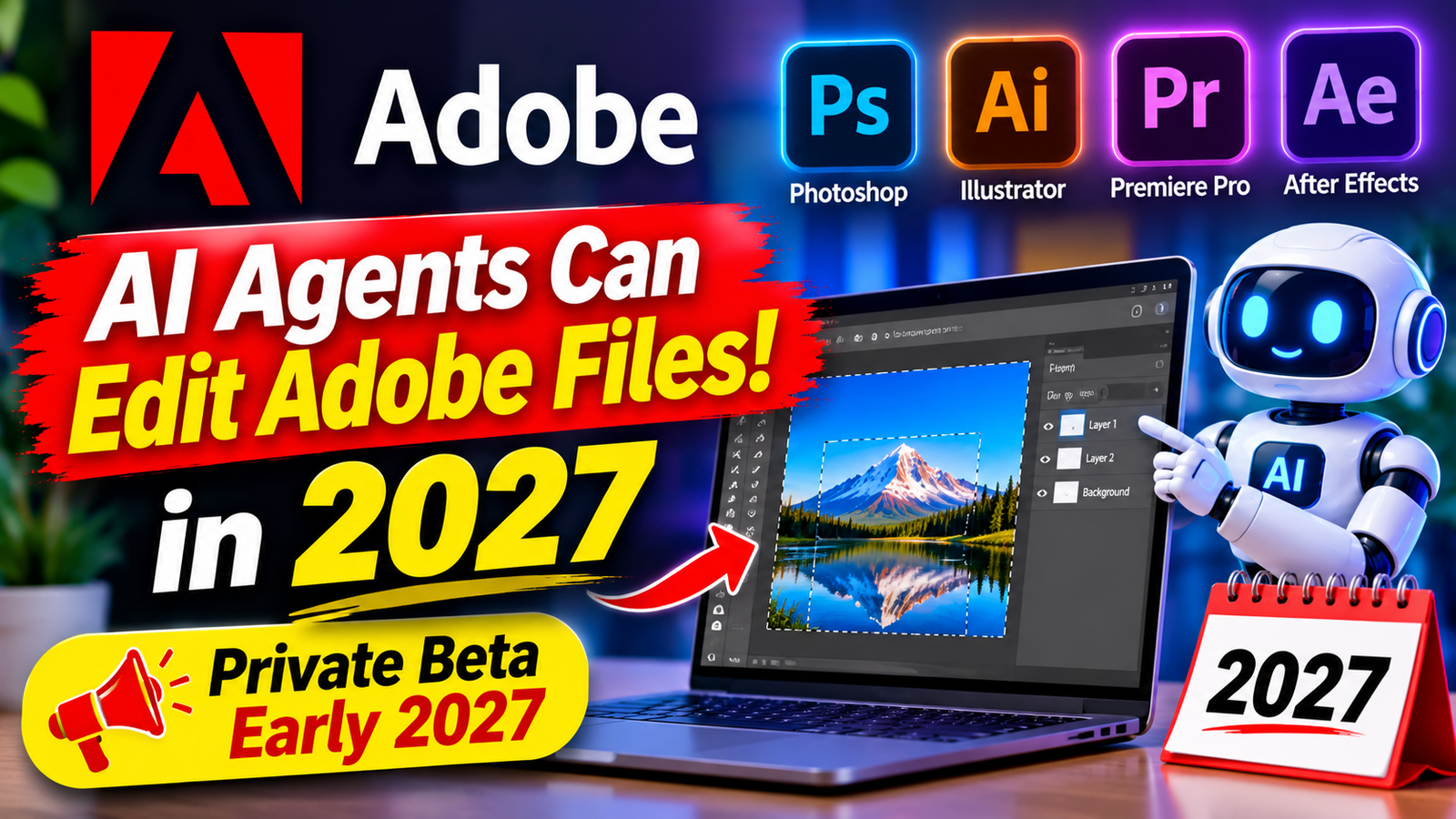
Adobe Previews AI Agents for Photoshop and Premiere Pro: Editing Comes in 2027: Adobe is preparing to introduce a new way for artificial intelligence (AI) agents to interact with professional creative software. The company has previewed local integrations that will allow external AI assistants to work directly with native project files in applications such as Photoshop, Illustrator, Premiere Pro and After Effects.
The announcement was made during Adobe MAX in Miami Beach on November 10, 2026. According to Adobe, the new integrations are expected to enter a private beta in early 2027.
This development could significantly change how designers, video editors and content creators use artificial intelligence in their daily workflows. Instead of simply generating images, suggesting edits or providing instructions, AI agents could eventually make changes directly inside existing creative projects.
One of the most important aspects of this approach is that the original project structure is expected to remain editable. This means creators could continue adjusting individual layers, vector elements, video sequences and other components after an AI agent completes a task.
However, the technology is not publicly available yet. Here is everything you need to know about Adobe’s upcoming AI integrations, the applications involved and what they could mean for creative professionals.
Adobe’s New AI Integration: How Will It Work?
Adobe’s upcoming integration is based on the Model Context Protocol (MCP), a standard that allows AI applications to communicate with external tools and services.
The company plans to use local MCP connections to let external AI agents interact with supported Adobe desktop applications installed on a user’s computer.
Potential AI assistants mentioned in connection with the planned integrations include ChatGPT, Claude and Gemini.
For example, imagine working on a promotional design in Photoshop. Instead of manually making every adjustment, you could potentially give an instruction to an external AI assistant.
The agent could then communicate with Photoshop and perform supported editing operations within the existing project.
A similar approach could eventually be used for video editing in Premiere Pro, vector illustrations in Illustrator and motion graphics projects in After Effects.
The important difference is that the AI agent would work with the actual creative project rather than simply producing a separate flattened image or exported video.
Adobe has also indicated that creators will remain in control of their work. They will be able to step in and refine the results whenever necessary.
The planned workflow will require the relevant Adobe desktop applications to be installed and licensed on the user’s computer.
Which Adobe AI Features Are Available Now?
Adobe’s latest announcement includes several AI-powered tools and improvements, but they do not all have the same availability status.
Some features are already available in beta, while others are still being prepared for future testing.
Understanding this difference is important because Adobe’s existing in-app AI assistants are separate from the upcoming local MCP integrations.
1. Local MCP Integrations
The local MCP integrations are among the most significant announcements from Adobe MAX.
They are designed to connect external AI agents with four major Creative Cloud applications:
- Adobe Photoshop
- Adobe Illustrator
- Adobe Premiere Pro
- Adobe After Effects
Through these connections, external AI assistants could potentially perform supported tasks inside installed desktop applications and modify native project files.
Adobe has previewed the technology, with a private beta planned for early 2027.
The company has not yet published a complete list of supported commands or confirmed a general public release date.
2. Creative Agent AI Assistants
Adobe is also expanding its own Creative Agent assistants.
These tools allow users to provide natural-language instructions and receive AI assistance within supported Creative Cloud applications.
The beta assistants are available in Premiere Pro, Illustrator, InDesign, After Effects and Frame.io.
Photoshop’s AI Assistant is available through the Photoshop beta application.
For example, Premiere Pro users can request certain editing operations, including applying effects across clips, tracking a masked subject and adjusting color or exposure across a sequence.
Users can then continue refining the results through the application’s regular editing controls.
These assistants work within Adobe products and should not be confused with the future external-agent connections.
3. Firefly Design and Firefly Graph
Adobe is also introducing improvements to its Firefly ecosystem through Firefly Design and Firefly Graph.
Firefly Design brings different creative formats into a shared editing environment. These include raster graphics, vector designs, motion, 3D and print-related work.
Firefly Graph focuses on connecting AI models and Adobe tools into repeatable creative workflows.
This could help creative professionals organize multiple steps of a production process and reuse workflows for different projects.
Both tools are currently in beta.
4. Firefly Builder
Firefly Builder is another interesting addition to Adobe’s AI ecosystem.
It is designed to turn natural-language instructions into interactive prototypes, such as websites and applications.
After generating a prototype, users can directly edit its individual elements.
Firefly Builder is currently in private beta. It is a separate initiative from the local MCP integrations planned for early 2027.
5. Other Creative Cloud Improvements
Adobe has also announced several improvements to its existing creative applications.
Premiere Pro’s Color Mode is generally available, while Generative Remove remains in beta.
InDesign Co-editing and Lightroom Open Eyes are also among the announced beta features.
These developments demonstrate Adobe’s broader strategy of bringing AI assistance into different stages of creative production.
How AI Agents Could Edit Photoshop and Premiere Pro Projects
The most interesting part of Adobe’s announcement is the possibility of allowing external AI agents to interact directly with native creative files.
Traditional AI image and video generators often provide finished outputs. Although these results can be useful, they may not offer the same editing flexibility as a fully structured project file.
Adobe’s planned integration aims to address this limitation.
Consider a Photoshop project containing multiple layers, text elements, background images and visual effects.
A creator could potentially ask an external AI assistant to make a specific change. The agent would communicate with Photoshop and perform the supported operation within the existing project.
Once the task is complete, the creator could continue editing individual elements using Photoshop’s regular tools.
The same concept could be useful for video editing. An AI agent could potentially interact with a Premiere Pro project while preserving its media organization and sequence structure.
The actual operations available will depend on the capabilities Adobe exposes through the integration.
Native Project Files Will Remain Editable
One of the biggest potential advantages of Adobe’s approach is its focus on preserving the structure of creative projects.
Here is how this could benefit different applications.
Adobe Photoshop
Photoshop projects frequently contain multiple layers for images, text, backgrounds and visual effects.
Keeping these layers editable would allow designers to refine individual elements after an AI agent makes changes, rather than working with a single flattened image.
Adobe Illustrator
Illustrator is widely used for logos, vector illustrations, icons and professional graphic design.
Preserving vector elements could allow designers to adjust individual shapes and other components without rebuilding the entire design.
Adobe Premiere Pro
Premiere Pro projects contain media bins, sequences and other editing elements.
Preserving these structures could help video editors continue working with their original footage and timelines instead of receiving only a completed video.
Adobe After Effects
After Effects is commonly used for motion graphics, animations and visual effects.
The application is included among the four planned MCP integrations. However, Adobe has not yet provided a separate detailed breakdown of exactly which project elements external agents will be able to modify.
Overall, keeping projects editable could make AI assistance more practical for professional creative work.
Could AI Agents Connect Adobe With Other Services?
Another interesting possibility is combining Adobe applications with other services through external AI agents.
For example, a creative professional could receive a project brief through Google Docs and use an AI assistant to organize the information before making changes to a design in Photoshop.
After the editing process, the same agent could potentially help share the completed work through Slack.
This type of workflow would depend on the external AI agent having the necessary integrations and permissions to access those separate services.
Adobe’s planned MCP integration focuses on connecting AI agents with local Creative Cloud desktop applications. It does not automatically provide access to every external platform.
Nevertheless, combining creative software with connected productivity services could make complex projects easier to manage.
Why Adobe’s AI Strategy Matters for Content Creators
Adobe’s announcement reflects a broader change in how artificial intelligence could be used in professional creative software.
Instead of treating AI as a separate tool for generating images and videos, Adobe is exploring ways to integrate AI assistance directly into existing production workflows.
This could be useful for several groups of professionals.
- Graphic designers: AI agents could help with supported adjustments to existing designs while preserving individual editable elements.
- Video editors: Natural-language instructions could simplify certain repetitive editing operations.
- Digital marketers: Creative teams could potentially use AI assistance to refine campaign assets and promotional materials.
- Content creators: AI-powered workflows could reduce the time spent on selected production tasks.
- Motion designers: External agents could eventually assist with supported operations in After Effects projects.
However, the actual benefits will depend on how reliably these integrations work and which operations Adobe makes available.
Human review will remain important, particularly for professional projects where visual quality, accuracy and creative direction matter.
When Will Adobe’s AI Agent Integration Launch?
Adobe has previewed its local MCP integrations, with a private beta planned for early 2027.
The initial announcement identifies Photoshop, Illustrator, Premiere Pro and After Effects as the supported applications.
The company has not yet announced a complete public release schedule or published a comprehensive list of editing commands available to external AI agents.
Users will also need the appropriate Adobe desktop applications installed and licensed to use the planned local workflow.
The upcoming private beta will be an important milestone because it should provide a clearer picture of how external AI assistants interact with native creative files.
It will also help establish which editing operations can be automated and how much direct control creators retain over their projects.
Final Thoughts
Adobe’s plan to let external AI agents edit native Creative Cloud project files could become an important development in AI-powered content creation.
The biggest change is that artificial intelligence may move beyond generating finished images and videos towards working directly inside professional creative applications.
Preserving Photoshop layers, Illustrator vector elements and Premiere Pro project structures could make this approach particularly useful for designers, video editors and creative teams.
However, the local MCP integrations are still in the preview stage, with a private beta planned for early 2027.
If Adobe successfully delivers this technology, creators could gain a more flexible way to combine AI automation with traditional editing tools while maintaining control over their creative projects.
Read Also: Samsung Galaxy S27 Wallpapers Leak Reveals 5 Possible Colours
1 thought on “Adobe Previews AI Agents for Photoshop and Premiere Pro: Editing Comes in 2027”
Comments are closed.