

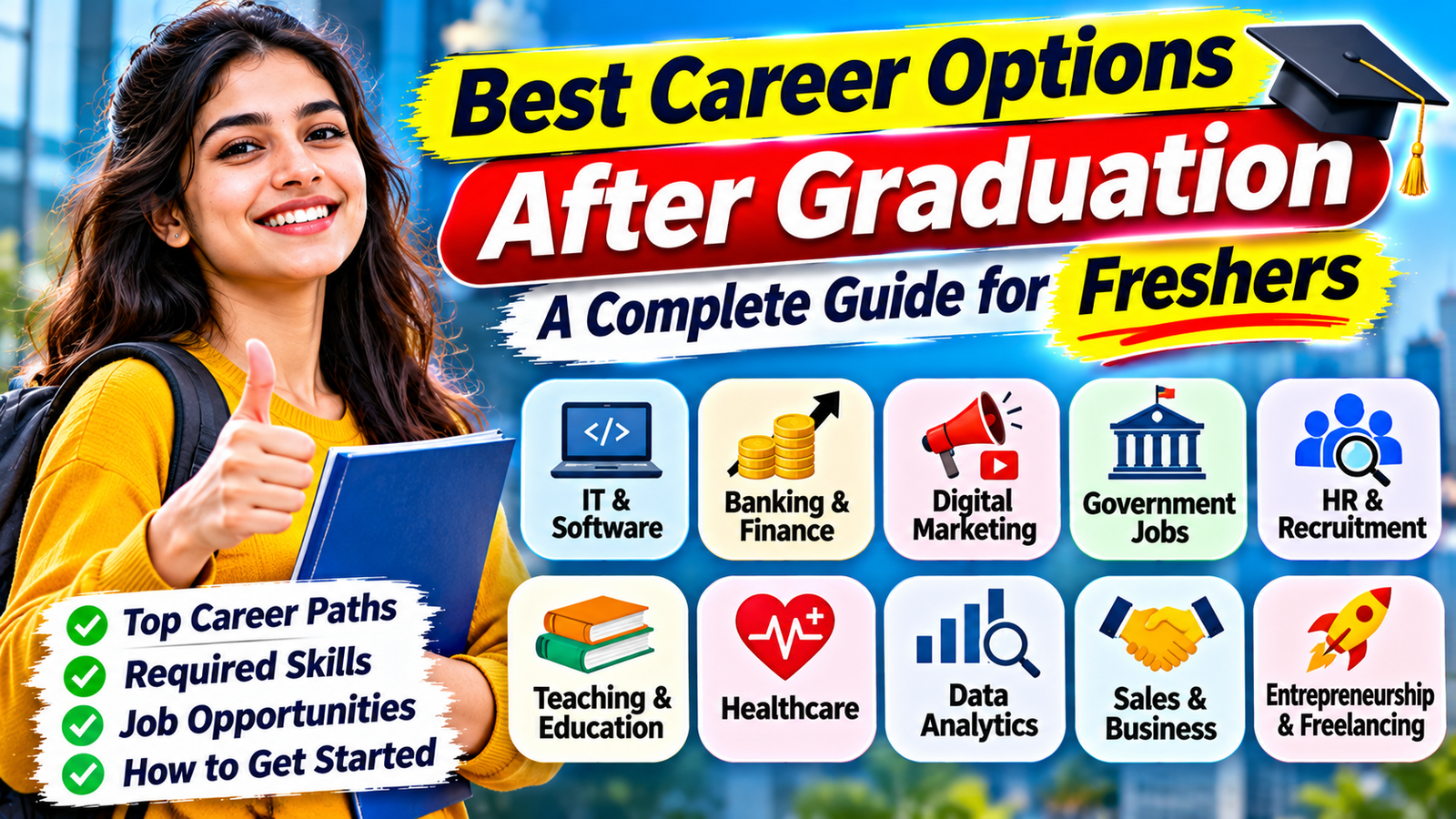
10 Best Career Options After Graduation: A Complete Guide for Freshers: Completing a graduation degree is an important milestone, but it can also bring a major question: What should you do next? Some graduates want to start working immediately, while others prefer higher education, professional training, competitive examinations or entrepreneurship. With so many possibilities available, choosing the right career path can feel confusing, especially for freshers who have little or no work experience.
The good news is that a graduate degree can open doors to opportunities across several industries. Your career options are not always limited to the subject you studied in college. For example, graduates from arts, commerce and science backgrounds can explore careers in administration, marketing, finance, technology, education and other fields, depending on their interests and qualifications.
However, the right career choice depends on more than salary or job popularity. You should consider your strengths, long-term goals, financial situation, interests and the skills required for each profession.
Here are 10 career options after graduation that freshers can explore, along with the qualifications, skills and practical steps needed to get started.
1. Information Technology and Software Development
Information technology is a popular career choice for graduates interested in computers, software and digital technology. Companies across different industries use software systems, websites, applications and digital platforms to manage their operations.
Freshers can explore entry-level roles such as junior software developer, web developer, IT support specialist, software tester and technical support associate.
A computer science or engineering degree can be helpful for some positions, but certain entry-level roles also accept candidates from other educational backgrounds if they have the required technical knowledge.
Skills to develop:
- Programming languages such as Python, Java or JavaScript
- HTML and CSS for web development
- Basic database knowledge
- Problem-solving and logical thinking
- Communication and teamwork
Beginners can start by learning one technical skill, building small projects and creating a portfolio to demonstrate their abilities.
2. Banking and Finance Careers
Banking and finance offer career opportunities for graduates interested in money management, financial services, accounting and business operations.
Possible entry-level roles include banking associate, accounts assistant, financial operations executive, loan processing associate and customer service representative.
Commerce, accounting, economics and business graduates may find their academic background useful. However, some employers accept graduates from different disciplines for suitable entry-level positions.
Skills to develop:
- Basic accounting and financial knowledge
- Microsoft Excel and spreadsheet management
- Communication and customer service
- Attention to detail
- Understanding of financial products and services
Graduates can also consider professional qualifications in accounting, finance or investment-related fields. Requirements vary by country and the specific role.
3. Digital Marketing and Social Media Management
Digital marketing has become an important part of how businesses promote their products and services. Companies use search engines, social media, websites, email and online advertising to reach customers.
Freshers can explore positions such as digital marketing executive, SEO assistant, social media coordinator, content marketing assistant and online advertising associate.
This field can be suitable for graduates who enjoy communication, creativity, research and working with digital platforms.
Skills to develop:
- Search engine optimisation (SEO)
- Social media marketing
- Content writing and editing
- Basic analytics and reporting
- Email marketing
- Advertising fundamentals
Practical experience can be valuable. Graduates can build a small portfolio by managing a personal blog, creating sample campaigns or working on projects for small businesses.
4. Government Jobs and Public Sector Careers
Government employment is an option for graduates who want to work in public administration, public services, law enforcement, finance or other government departments.
Depending on the country, graduates may be eligible for civil service examinations, administrative positions, public-sector banking roles, clerical positions and other recruitment programmes.
In India, for example, graduates can explore examinations conducted by organisations such as the Union Public Service Commission, Staff Selection Commission and various state recruitment authorities. Each examination has its own eligibility rules, age limits and selection process.
Skills to develop:
- General knowledge and current affairs
- Reasoning and analytical ability
- Quantitative aptitude
- Language and writing skills
- Time management and exam preparation
Government recruitment can be competitive, so candidates should understand the official examination syllabus and selection process before preparing.
5. Human Resources and Recruitment
Human resources (HR) professionals help organisations manage employees, recruitment, workplace policies and staff development.
Freshers can begin with roles such as HR assistant, recruitment coordinator, talent acquisition associate and HR operations executive.
Graduates from business administration, commerce, psychology, sociology and other disciplines may explore this field, depending on employer requirements.
Skills to develop:
- Communication and interpersonal skills
- Interview coordination
- Basic employment and workplace knowledge
- Documentation and record management
- Problem-solving and organisation
A course or qualification in human resource management can be helpful for graduates who want to specialise in this area.
6. Teaching and Education
Teaching is a career option for graduates who enjoy explaining concepts, helping students learn and working in educational environments.
Possible opportunities include private tutoring, teaching assistance, educational content development, academic coordination and school teaching, depending on the relevant qualifications.
In many countries, becoming a qualified schoolteacher requires additional teacher training, registration or certification. In India, for example, certain school teaching positions require qualifications such as B.Ed. and may involve eligibility examinations depending on the level and institution.
Skills to develop:
- Subject knowledge
- Communication and presentation
- Classroom management
- Patience and organisation
- Lesson planning and teaching methods
Graduates interested in teaching should research the specific qualifications required for their preferred education level and location.
7. Healthcare and Allied Health Careers
Healthcare is a broad industry that includes hospitals, laboratories, clinics, rehabilitation centres and other medical services.
Graduates with relevant science or healthcare qualifications may explore careers in laboratory services, healthcare administration, public health support and other allied health areas.
Possible roles include medical laboratory technician, healthcare administration assistant, clinical research assistant and public health programme assistant. However, some of these positions require specialised degrees, practical training, professional registration or licensing.
Skills to develop:
- Relevant scientific or healthcare knowledge
- Attention to detail
- Communication and teamwork
- Documentation and record management
- Understanding of safety and confidentiality
Graduates should check professional requirements carefully because healthcare responsibilities and licensing rules vary significantly between occupations and countries.
8. Sales and Business Development
Sales and business development professionals help organisations find customers, build relationships and generate business opportunities.
Freshers can apply for suitable positions such as sales executive, business development associate, customer relationship executive and inside sales representative.
This field can be suitable for graduates who enjoy communication, meeting people, understanding customer needs and working towards measurable targets.
Skills to develop:
- Communication and negotiation
- Customer relationship management
- Product and market knowledge
- Presentation skills
- Problem-solving and confidence
Some sales roles provide structured training for new employees. Candidates should understand the salary structure, incentives, targets and working conditions before accepting an offer.
9. Data Analytics and Business Analytics
Businesses collect information about customers, sales, operations and market performance. Data analysts help organisations understand this information and use it to support decisions.
Fresh graduates can explore junior data analyst, reporting assistant, business analyst trainee and data operations roles, depending on their technical and educational background.
A degree in mathematics, statistics, economics, computer science or business can be useful, although some employers consider candidates from other disciplines who demonstrate the necessary skills.
Skills to develop:
- Microsoft Excel
- SQL fundamentals
- Data visualisation tools
- Basic statistics
- Analytical thinking
- Clear communication of findings
Beginners can practise with publicly available datasets and create simple projects that demonstrate how they collect, analyse and present information.
10. Entrepreneurship and Freelancing
Graduation does not mean that every person must immediately take a traditional full-time job. Some graduates may prefer starting a small business or offering freelance services.
Possible freelance areas include graphic design, content writing, web development, video editing, translation, digital marketing and virtual assistance.
Entrepreneurship may involve launching an online store, providing local services, building a digital product or developing a business around a particular skill.
Skills to develop:
- Business planning
- Communication and networking
- Financial management
- Marketing and customer service
- Time management
- A marketable professional skill
Freelancing and business ownership can offer flexibility, but income may be unpredictable, especially during the early stages. It is sensible to start with manageable projects and understand the costs before making a major financial commitment.
How to Choose the Right Career After Graduation
With several career paths available, selecting one can be challenging. Instead of choosing a profession only because it is popular, evaluate whether it matches your abilities and long-term goals.
Consider these important factors:
1. Understand your interests: Identify the subjects, activities and types of work you genuinely enjoy. This can help you choose a career that you are more likely to stay motivated in.
2. Evaluate your strengths: Think about whether you are better at communication, mathematics, technology, writing, organisation, problem-solving or practical work.
3. Research job requirements: Check the qualifications, experience, certifications and skills employers expect from entry-level candidates.
4. Consider financial needs: Compare starting salaries, training costs, location and the time required to qualify for a profession.
5. Look at long-term opportunities: Research possible career progression, further education options and the skills that may help you move into more advanced positions.
Essential Skills Every Fresher Should Develop
Regardless of your graduation subject, certain transferable skills can improve your readiness for employment.
- Communication: Learn to express ideas clearly in writing and conversation.
- Digital literacy: Become comfortable using computers, online tools and productivity applications.
- Problem-solving: Practise analysing situations and finding practical solutions.
- Teamwork: Learn to collaborate with people from different backgrounds.
- Adaptability: Be prepared to learn new tools, technologies and working methods.
- Professional writing: Develop the ability to prepare emails, reports and a clear resume.
Freshers can strengthen these skills through online courses, internships, volunteer work, practical projects and independent learning.
How to Get Your First Job After Graduation
Getting the first job can take time, but a structured approach can make the process easier.
Start by preparing a professional resume that highlights your education, relevant skills, internships, projects and achievements. If you do not have employment experience, focus on academic projects, practical assignments and volunteering.
Create a professional profile on suitable job platforms and search for entry-level positions that match your qualifications. Research employers before applying and customise your application to the job description.
You should also prepare for interviews by practising common questions, learning about the company and explaining why you are interested in the role.
Most importantly, avoid paying unknown recruiters for guaranteed job offers. Verify employers and recruitment agencies before sharing personal documents or making payments.
Final Thoughts
Choosing a career after graduation is an important decision, but you do not need to have your entire professional future planned immediately. IT, finance, digital marketing, government services, HR, education, healthcare, sales, data analytics and entrepreneurship are some of the paths freshers can explore.
The best option depends on your educational background, interests, abilities, financial needs and career goals. Some professions require additional qualifications, while others allow graduates to begin with entry-level training and practical experience.
Focus on developing useful skills, gaining real-world experience and researching genuine opportunities. With consistent learning and careful planning, you can take meaningful steps towards building a successful career after graduation.
Read Also: Apprenticeships vs Internships vs Entry-Level Jobs: Which Is Best?
1 thought on “10 Best Career Options After Graduation: A Complete Guide for Freshers”
Comments are closed.