

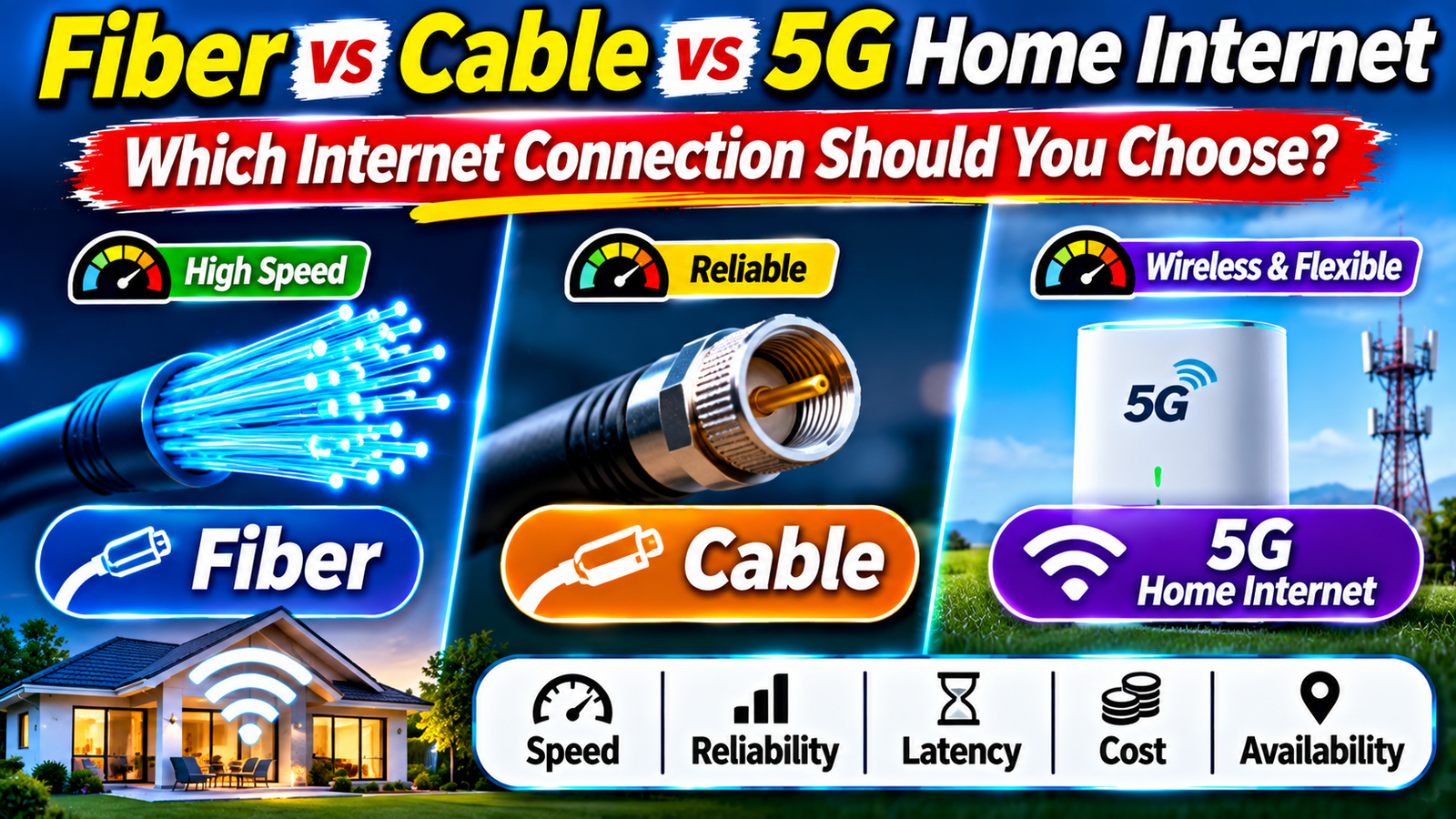
Fiber vs Cable vs 5G Home Internet: Which Internet Connection Should You Choose?: Choosing the right home internet connection has become increasingly important as more people work remotely, attend online classes, stream movies, play online games and use connected devices. A reliable internet connection can make everyday digital activities easier, but selecting the right technology is not always simple.
Today, three popular options are fiber internet, cable internet and 5G home internet. Each provides internet access differently, and each comes with its own advantages and limitations.
Fiber internet uses optical signals transmitted through fiber-optic cables. Cable internet relies on cable television infrastructure, while 5G home internet delivers connectivity wirelessly through a cellular network.
Although all three options can support everyday internet activities, their performance may vary depending on the provider, location, network conditions, equipment and subscription plan.
So, which one should you choose? This guide compares fiber, cable and 5G home internet based on speed, reliability, latency, pricing, availability and everyday usage.
1. What Is Fiber Internet?
Fiber internet is a broadband connection that uses fiber-optic cables to transmit information through pulses of light. These cables are designed to carry large amounts of data over long distances with relatively low signal loss.
Fiber connections are known for offering high speeds and low latency. Many providers offer plans with download and upload speeds that are similar, making fiber particularly useful for activities that require sending large amounts of data.
For example, people who regularly upload large files, participate in video meetings, back up data to cloud storage or create online content may benefit from fiber’s upload capabilities.
Key features of fiber internet:
- High download and upload speeds
- Often symmetrical speed plans
- Low latency
- Reliable performance when properly maintained
- Suitable for multiple connected devices
- Requires fiber infrastructure in the service area
Advantages:
Fiber can deliver excellent performance for demanding internet activities. Its high bandwidth makes it suitable for households where several people stream videos, play games, attend meetings and download files simultaneously.
Another advantage is its upload performance. Unlike many traditional broadband plans, fiber services commonly offer upload speeds closer to their download speeds.
Disadvantages:
Fiber is not available everywhere. Some residential areas may not have fiber infrastructure, particularly remote locations or buildings that have not yet been connected to a provider’s network.
Installation may also require a technician, additional equipment or an installation appointment. The actual cost and availability depend on the service provider.
2. What Is Cable Internet?
Cable internet uses the same general coaxial cable infrastructure that has traditionally been used to deliver cable television services. A cable modem connects the household to the provider’s network.
Cable broadband is widely available in many areas where cable television infrastructure already exists. It can offer high download speeds and is suitable for common household activities such as streaming, browsing, online learning and gaming.
However, cable networks often have shared capacity in neighbourhoods. This means performance can sometimes change depending on how many customers are using the local network at the same time.
Key features of cable internet:
- Uses coaxial cable infrastructure
- High download speeds on many plans
- Often widely available in developed areas
- Suitable for streaming and general internet use
- Upload speeds are commonly lower than download speeds
Advantages:
One of the main benefits of cable internet is availability. In locations where cable infrastructure is already installed, households may be able to get connected without waiting for an entirely new network to be built.
Cable internet can also provide enough speed for households with several users. It can support HD and 4K streaming, online meetings, gaming and large downloads when the selected plan and network conditions are suitable.
Disadvantages:
Upload speeds are often lower than download speeds, although this depends on the provider and network technology.
Performance can also fluctuate during busy periods because neighbourhood capacity may be shared. This does not mean cable internet is always slow during peak hours, but congestion can affect some connections.
3. What Is 5G Home Internet?
5G home internet uses fifth-generation mobile network technology to provide broadband connectivity to a home. Instead of receiving internet through a physical fiber or coaxial cable connection, a compatible home gateway or router connects wirelessly to a nearby cellular network.
The router then distributes the internet connection to smartphones, laptops, televisions and other household devices through Wi-Fi or supported wired connections.
This technology can be attractive for people who want a home internet connection without traditional broadband cabling.
Key features of 5G home internet:
- Wireless connection through a 5G cellular network
- Home gateway or compatible router
- No traditional fiber or coaxial cable connection to the home
- Performance depends on network coverage and signal quality
- Availability depends on the mobile operator’s service area
Advantages:
One of the biggest advantages of 5G home internet is installation flexibility. Depending on the provider, users may only need to place a compatible router in a location with a strong cellular signal.
It can also be useful in areas where fiber or cable broadband is unavailable or difficult to install.
For households that mainly browse websites, stream videos, attend online meetings and use social media, a good 5G connection may provide sufficient performance.
Disadvantages:
5G home internet performance can vary based on signal strength, network congestion, distance from cellular equipment, building materials and the number of active users.
Weather and physical obstacles may also influence wireless signal conditions in some situations.
Unlike a dedicated wired connection, 5G home internet depends on the cellular network’s available capacity. Therefore, users should check real-world performance in their location before choosing a plan.
4. Fiber vs Cable vs 5G: Speed Comparison
Speed is one of the first things people consider when selecting an internet connection. However, advertised maximum speeds do not always represent the performance a household will experience.
Fiber providers often offer high download and upload speeds, including symmetrical plans. Cable providers can also offer fast download speeds, but upload speeds may be more limited depending on the network.
5G home internet can deliver competitive speeds in areas with strong network coverage, although actual performance may change throughout the day.
| Feature | Fiber | Cable | 5G Home Internet |
|---|---|---|---|
| Technology | Fiber-optic cables | Coaxial cables | Cellular wireless |
| Download speed | Often very high | Often high | Varies by location |
| Upload speed | Often high | Usually lower than download | Varies by network |
| Latency | Generally low | Generally moderate to low | Can vary |
| Connection type | Wired | Wired | Wireless |
| Performance consistency | Generally strong | Can vary with congestion | Depends on signal and congestion |
| Installation | Fiber connection required | Cable connection required | Compatible home gateway |
The best way to compare providers is to check their advertised download and upload speeds, typical performance information and any applicable data limits.
5. Which Internet Connection Is Best for Online Gaming?
Online gaming requires more than a fast download speed. Latency, jitter, packet loss and connection stability can influence the gaming experience.
Latency refers to the time taken for data to travel between your device and a server. Lower latency is generally better for activities that require quick responses, including competitive online games.
Fiber is often an excellent choice for online gaming because it generally offers low latency and consistent performance.
Cable internet can also provide a good gaming experience, particularly when the network is not congested and the connection is stable.
5G home internet can work for gaming, but performance may fluctuate depending on cellular signal quality and network conditions. Competitive players should test the connection before relying on it.
General recommendation: Fiber is often the preferred option for serious online gaming, while cable can be a suitable alternative. A strong 5G connection may also work for casual gaming.
6. Which Is Better for Streaming and Working from Home?
Streaming services, remote work and online education have become common reasons for purchasing home broadband.
For video streaming, all three technologies can work well when they provide sufficient bandwidth and stable performance. The required speed depends on video quality, the number of simultaneous streams and other household internet activities.
Remote workers may need reliable video calls, file uploads, cloud applications and access to company systems.
Fiber is particularly useful for households that regularly upload large files or conduct multiple video meetings. Cable can also handle many remote-work requirements, although upload speeds should be checked carefully.
5G home internet may be a practical alternative for people who have strong cellular coverage and suitable data allowances.
Before selecting a plan, consider how many people will use the connection simultaneously and whether your work requires frequent large uploads.
7. Pricing and Installation Costs
Internet pricing depends on the provider, location, speed tier, promotional offers, contract terms and additional equipment charges.
Fiber installation may involve a setup fee or technician visit, depending on the provider and whether the property already has a fiber connection.
Cable providers may offer competitive packages in areas with existing infrastructure. However, customers should check equipment rental charges, promotional pricing periods and contract conditions.
5G home internet may offer simpler installation because it generally uses a wireless gateway. Some providers include equipment in the monthly subscription, while others may apply additional charges.
Before signing up, compare the total cost rather than looking only at the advertised monthly price.
Check these details:
- Monthly subscription cost
- Installation or activation fees
- Router or modem charges
- Data limits and fair-use policies
- Contract duration and cancellation fees
- Price changes after promotional periods
8. How to Choose the Right Internet Connection
The best connection depends on your location, budget and internet usage.
Choose fiber if:
- You need fast download and upload speeds.
- Several people use the internet simultaneously.
- You work from home and upload large files.
- You play online games and prefer low latency.
- Fiber service is available at a reasonable price.
Choose cable if:
- Fiber is unavailable in your area.
- You need reliable broadband for everyday activities.
- Your provider offers a suitable speed and upload plan.
- You want to use existing cable infrastructure.
Choose 5G home internet if:
- Fiber and cable options are limited.
- You have strong 5G coverage at home.
- You prefer a wireless home internet setup.
- You want an alternative to traditional wired broadband.
Before choosing 5G, test signal strength in different parts of your home if possible. For cable and fiber, compare the actual service plans available at your address.
Final Thoughts
Fiber, cable and 5G home internet all offer ways to connect your home to the internet, but they serve different needs.
Fiber is often the strongest overall choice for households that want high speeds, strong upload performance and low latency. Cable remains a practical option for many homes, especially where fiber infrastructure is unavailable. 5G home internet offers flexibility and can be a useful alternative where cellular coverage is strong.
There is no universal winner for every household. The right decision depends on local availability, pricing, network performance and the activities you use the internet for.
Before subscribing, compare the available providers, check upload speeds and data policies, and review the total monthly cost. Choosing a connection based on your actual needs can help you get better value and a more satisfying internet experience.
Read Also: GTA 6 Before You Buy: 10 Essential Requirements Every Gamer Must Know
1 thought on “Fiber vs Cable vs 5G Home Internet: Which Is Best for You?”
Comments are closed.