

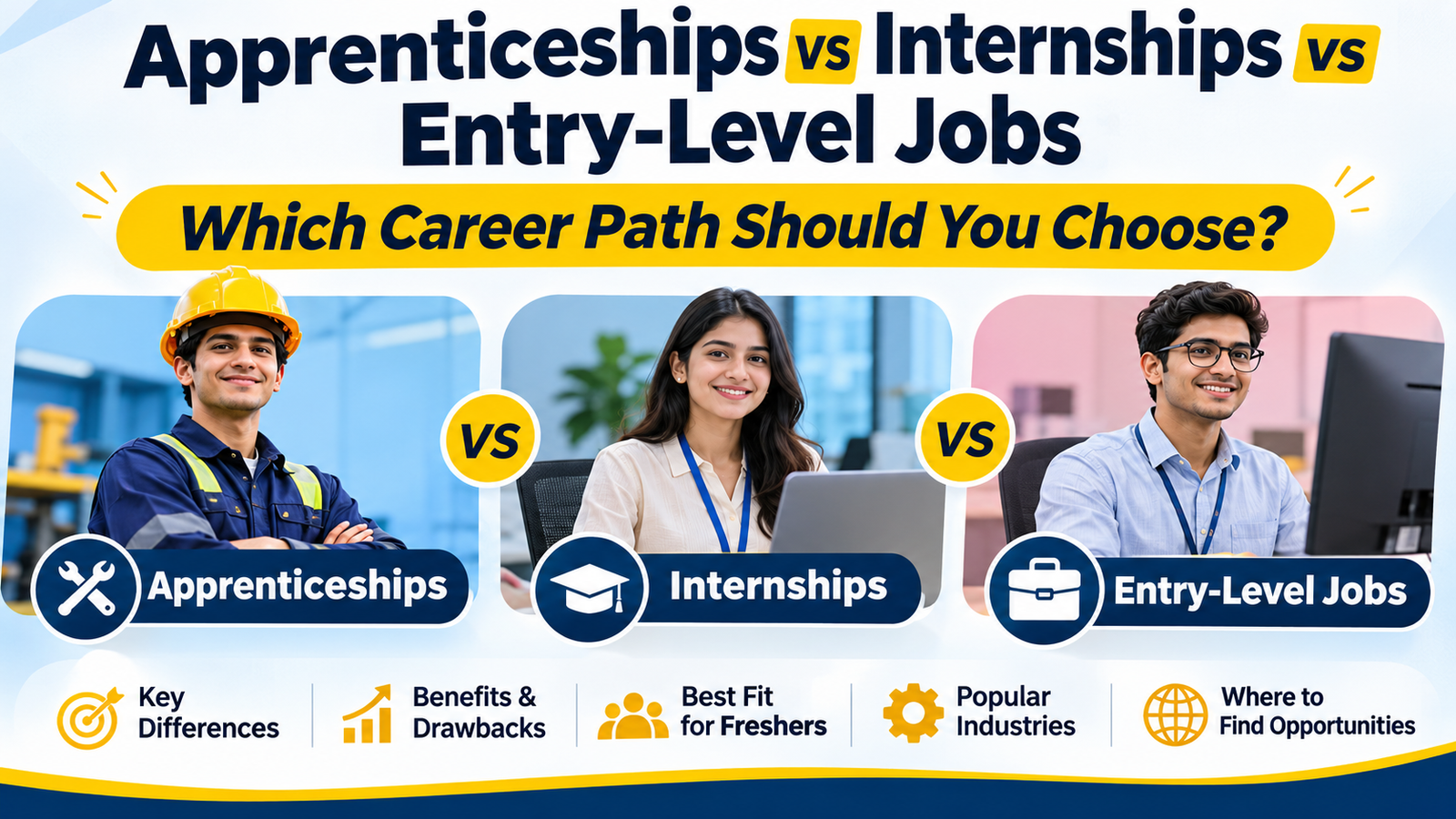
Apprenticeships vs Internships vs Entry-Level Jobs: Which Career Path Should You Choose?
Starting a career can be challenging, especially when you have recently completed school, college or university and are trying to find your first professional opportunity. Many employers advertise apprenticeships, internships and entry-level jobs, but these opportunities are not the same. Each offers a different way to gain experience, develop professional skills and build a long-term career.
For fresh graduates, students and people changing careers, choosing the right path can make a significant difference. Some opportunities focus on practical training, while others provide short-term industry experience or a direct route into regular employment.
Whether you are looking for opportunities in the United States, United Kingdom, Canada, Australia or India, understanding these three career options can help you make a more informed decision.
In this guide, we explain the differences between apprenticeships, internships and entry-level jobs, including their benefits, disadvantages, earning potential, eligibility requirements and career opportunities.
What Is an Apprenticeship?
An apprenticeship is a structured training programme that combines practical workplace experience with formal or classroom-based learning. It allows individuals to learn a specific occupation while working under the guidance of experienced professionals.
Unlike many traditional training programmes, apprenticeships often allow participants to earn money while developing job-related skills.
Apprenticeships are commonly available in industries such as:
- Information technology and cybersecurity
- Engineering and manufacturing
- Construction and electrical work
- Healthcare and social care
- Automotive and mechanical services
- Hospitality and professional services
For example, someone interested in becoming an electrician can join an apprenticeship programme, learn electrical installation techniques, work alongside experienced electricians and gradually develop the skills required for the profession.
Depending on the country, employer and occupation, an apprenticeship may last several months or multiple years.
Benefits of Apprenticeships
1. Earn While You Learn
Many formal apprenticeship programmes provide wages during training. This allows participants to gain professional experience without depending entirely on unpaid educational opportunities.
2. Practical Work Experience
Apprentices spend time learning through real workplace responsibilities. This helps them understand how their chosen industry operates.
3. Professional Qualifications
Some recognised apprenticeship programmes provide industry-approved qualifications or certificates after successful completion.
4. Mentorship and Guidance
Apprentices generally receive supervision and guidance from experienced workers who help them improve their technical and professional skills.
5. Career Development
Completing an apprenticeship can improve employment opportunities, particularly in occupations where practical experience and recognised qualifications are important.
Disadvantages of Apprenticeships
- Training can take several years.
- Some programmes require specific educational qualifications.
- The training may focus on a particular occupation.
- Working hours can be demanding depending on the industry.
- Changing career paths during training may require additional preparation.
What Is an Internship?
An internship is a temporary work experience opportunity that allows students, graduates and beginners to understand how a particular industry or profession operates.
Internships are particularly popular among college students and recent graduates who want to develop practical skills before applying for permanent positions.
For example, a computer science student may join a software development internship to learn programming, work with development teams and understand real-world software projects.
Internships are available across several industries, including:
- Software development and IT
- Digital marketing and advertising
- Banking and finance
- Human resources
- Journalism and media
- Education and research
- Business administration
- Graphic design and content creation
Internship duration varies by employer and country. Some last a few weeks, while others continue for several months.
Internships can be paid or unpaid, depending on local employment laws, the employer and the structure of the programme.
Benefits of Internships
1. Industry Exposure
Internships introduce participants to professional workplaces and help them understand the responsibilities associated with different job roles.
2. Resume Development
Relevant internship experience can strengthen a resume, particularly when applying for jobs that require practical knowledge.
3. Networking Opportunities
Interns can connect with experienced professionals, managers and colleagues who may provide career guidance.
4. Opportunity to Explore Careers
Students can discover whether a particular profession matches their interests before committing to a long-term career.
5. Potential Full-Time Employment
Some employers consider successful interns for permanent positions. However, a full-time job is not guaranteed after completing an internship.
Disadvantages of Internships
- Some internships are unpaid.
- Training quality varies between employers.
- Temporary positions may offer limited responsibilities.
- Not every internship provides a recognised qualification.
- Permanent employment is not guaranteed.
Before accepting an internship, candidates should understand the responsibilities, payment arrangements, training opportunities and expected working hours.
What Are Entry-Level Jobs?
An entry-level job is a position designed for people who are beginning their professional careers or have limited experience in a particular occupation.
These positions provide an opportunity to enter the workforce, earn a regular income and develop professional skills through actual employment.
Unlike apprenticeships, entry-level jobs do not always include a formal training qualification. Similarly, unlike internships, they are generally regular employment positions rather than temporary learning placements.
Common entry-level job opportunities include:
- Customer service representative
- Junior software developer
- Administrative assistant
- Sales associate
- Data entry operator
- IT support technician
- Junior accountant
- Marketing assistant
- Banking associate
- Healthcare support worker
For example, a recent business graduate may apply for an entry-level banking position. The employer may provide initial training before assigning regular responsibilities.
Some entry-level positions require a university degree, professional certificate or technical skills, while others accept candidates with a high school qualification.
Benefits of Entry-Level Jobs
1. Regular Employment Income
Entry-level positions generally provide wages or salaries according to the employer’s employment agreement and applicable labour laws.
2. Professional Experience
Employees gain experience by handling real responsibilities, communicating with colleagues and working with customers or clients.
3. Career Growth
Entry-level positions can provide a foundation for future promotions and more specialised professional roles.
4. Workplace Skills
Employees develop communication, teamwork, problem-solving, time management and technical skills.
5. Greater Employment Stability
Permanent entry-level positions may offer more employment continuity than temporary internships, although job security depends on the employment contract and employer.
Disadvantages of Entry-Level Jobs
- Some positions offer limited initial salaries.
- Employers may expect basic technical knowledge.
- Career progression can take time.
- Training may be less structured than an apprenticeship.
- Competition can be high for popular positions.
Apprenticeships vs Internships vs Entry-Level Jobs: Key Differences
Understanding the differences between these three opportunities makes it easier to select the right career pathway.
| Feature | Apprenticeship | Internship | Entry-Level Job |
|---|---|---|---|
| Main purpose | Learn an occupation | Gain industry experience | Start employment |
| Duration | Often long-term | Usually temporary | Depends on contract |
| Payment | Often paid | Paid or unpaid | Usually paid |
| Training | Structured | Varies | Employer-dependent |
| Qualification | May provide recognised qualification | Usually no formal qualification | Depends on role |
| Mentorship | Usually included | Varies | Varies |
| Work experience | Extensive practical training | Limited or project-based | Regular responsibilities |
| Full-time employment | Possible | Not guaranteed | Already employed |
| Best suited for | Skill-based careers | Students and graduates | Job seekers and freshers |
These are general comparisons, not universal employment rules. Conditions vary across countries, industries and individual programmes.
Which Career Path Is Best for Freshers?
The right option depends on your educational background, career goals, financial situation and the type of work you want to pursue.
Here is how different candidates can approach the decision.
1. Students Who Want Industry Experience
An internship may be the best starting point for students who want to understand a profession while continuing their education.
For example, students studying computer science, business administration, engineering or media can explore internships related to their academic subjects.
2. Candidates Who Prefer Practical Training
An apprenticeship can be a good choice for people who want to develop specialised skills through hands-on experience.
It is particularly useful for careers in electrical work, construction, automotive services, engineering and certain IT occupations.
3. Recent Graduates Looking for Employment
Entry-level jobs may be suitable for graduates who have completed their education and want to begin earning a regular income.
Candidates can search for junior positions, graduate recruitment programmes, trainee roles and assistant-level opportunities.
4. People Changing Careers
People moving into a different industry can consider all three options.
An internship may help them explore a new field, an apprenticeship may provide structured technical training, and an entry-level position may offer a direct route into a new occupation.
Popular Industries Offering These Career Opportunities
These career pathways are not limited to technology companies. Many industries recruit beginners through different training and employment arrangements.
Information Technology: Software development, IT support, networking, cybersecurity and cloud computing.
Engineering: Mechanical engineering, electrical engineering, civil engineering and manufacturing.
Healthcare: Healthcare assistance, laboratory support, administration and selected clinical training pathways. Regulated clinical professions may require specific qualifications and licences.
Banking and Finance: Banking operations, customer support, accounting assistance and financial administration.
Education: Teaching assistance, educational administration and training support.
Skilled Trades: Electricians, plumbers, carpenters, mechanics and construction workers.
Business and Marketing: Sales, digital marketing, human resources and business administration.
The availability of apprenticeships, internships and entry-level positions depends on local industry requirements and employer recruitment policies.
Where Can You Find Apprenticeships, Internships and Entry-Level Jobs?
Job seekers should use official employment websites, recognised recruitment platforms and employer career pages.
Here are useful resources for different countries.
United States
- Apprenticeships: https://www.apprenticeship.gov/
- Government jobs: https://www.usajobs.gov/
- Employment resources: https://www.careeronestop.org/
United Kingdom
- Apprenticeships: https://www.gov.uk/apply-apprenticeship
- Government jobs: https://www.civilservicejobs.service.gov.uk/
Canada
- Job Bank: https://www.jobbank.gc.ca/
- Apprenticeship information: https://www.canada.ca/en/services/jobs/training/support-skilled-trades-apprentices.html
Australia
- Apprenticeships: https://www.apprenticeships.gov.au/
- Employment resources: https://www.workforceaustralia.gov.au/
India
- National Apprenticeship Training Scheme: https://nats.education.gov.in/
- National Apprenticeship Promotion Scheme: https://www.apprenticeshipindia.gov.in/
- Government employment services: https://www.ncs.gov.in/
Always check the official eligibility requirements, application deadlines, payment conditions and employer details before applying.
Important Tips Before Applying
Before accepting any opportunity, consider the following points:
- Check Eligibility: Review educational qualifications, age requirements, experience and other conditions.
- Understand Payment: Confirm whether the position is paid, unpaid or provides a training allowance.
- Read the Job Description: Understand your responsibilities, working hours and expected skills.
- Research the Employer: Apply through official company websites or trusted recruitment platforms.
- Avoid Recruitment Scams: Never pay suspicious recruitment fees or share sensitive banking information with unverified recruiters.
- Consider Long-Term Growth: Choose opportunities that help you develop useful skills and move towards your career goals.
Frequently Asked Questions (FAQs)
1. Is an apprenticeship better than an internship?
An apprenticeship may be better for people seeking structured occupational training and practical skills. An internship may be more suitable for students who want short-term industry exposure. The better option depends on individual career goals.
2. Can freshers apply for entry-level jobs?
Yes. Many entry-level positions are designed for freshers and candidates with limited professional experience. However, educational and technical requirements vary by employer.
3. Are apprenticeships paid?
Many formal apprenticeship programmes are paid. However, payment arrangements and legal requirements depend on the country, programme and employer.
4. Can an internship lead to a permanent job?
Yes. Some companies recruit successful interns for permanent positions. However, employers are not necessarily required to offer full-time employment after an internship.
5. Which is better for students: an internship or an apprenticeship?
Internships are useful for exploring industries and gaining short-term work experience. Apprenticeships are useful for students who want structured occupational training while gaining practical experience.
6. Can I get a job after completing an apprenticeship?
Completing an apprenticeship can improve your employment prospects by providing practical skills and, in some programmes, recognised qualifications. However, employment after completion is not guaranteed.
7. Do entry-level jobs require previous experience?
Not always. Many entry-level jobs accept candidates without previous professional experience, although some employers prefer candidates with internships, projects or relevant certifications.
Conclusion
Apprenticeships, internships and entry-level jobs each offer different opportunities for building a successful career.
An apprenticeship is suitable for individuals who want structured practical training and occupation-specific skills. An internship is useful for students and graduates who want industry exposure and professional experience. An entry-level job is a practical choice for candidates who are ready to begin regular employment.
There is no single best option for everyone. Consider your qualifications, financial needs, interests and long-term career goals before making a decision.
The most important thing is to choose an opportunity that helps you gain valuable experience, develop relevant skills and move closer to your professional goals.
Read Also: 10 Best Private-Sector Jobs Without a Degree: Unlock Career Opportunities
1 thought on “Apprenticeships vs Internships vs Entry-Level Jobs: Which Is Best?”
Comments are closed.