

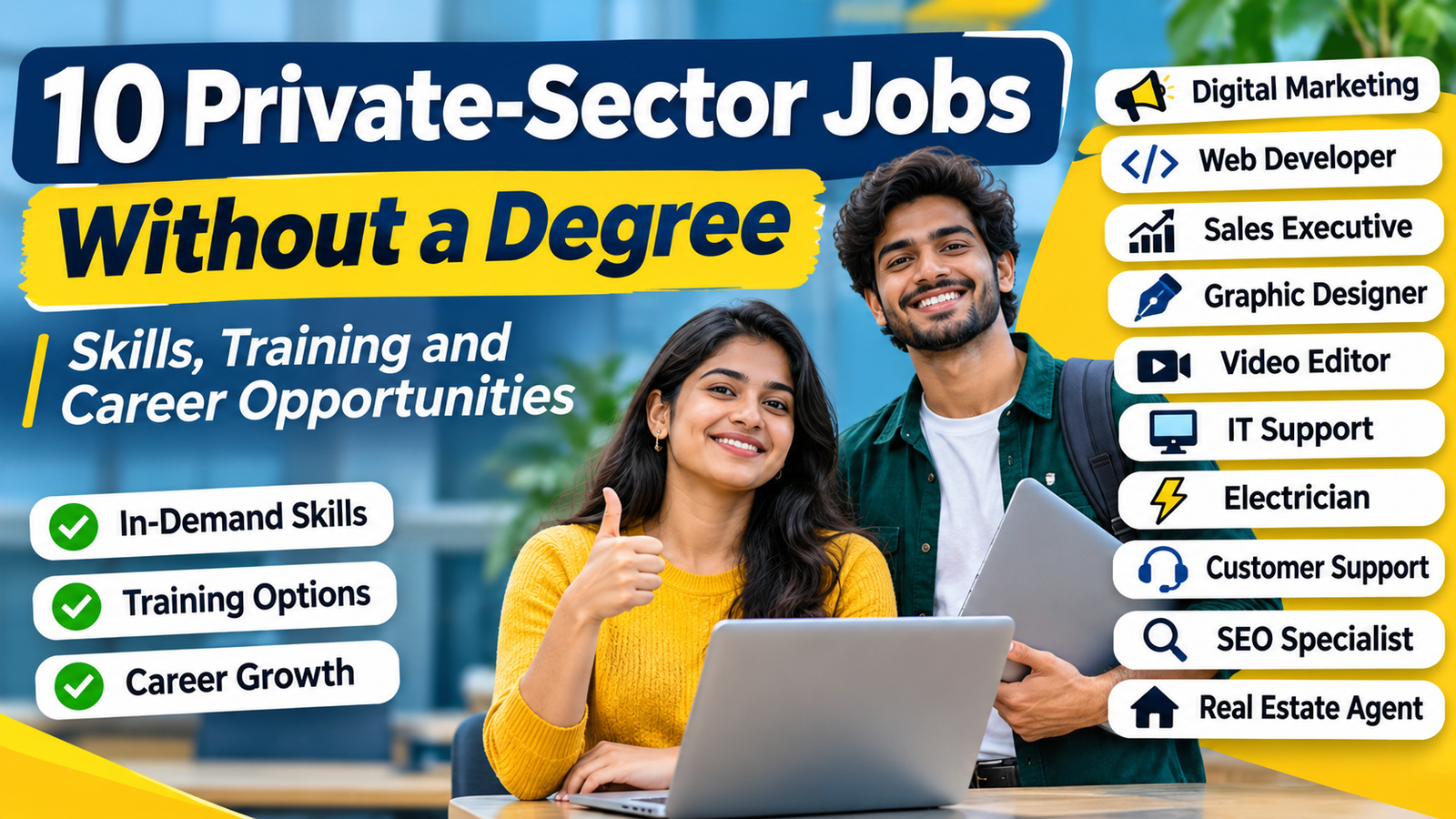
10 Best Private-Sector Jobs Without a Degree: Unlock Career Opportunities: A university degree can open many career opportunities, but it is not the only way to build a successful career. Many private-sector employers also consider candidates based on practical skills, relevant experience, professional training, certifications and their ability to perform the job.
For people who have completed high school, left college before graduation, or want to enter the workforce through skill-based learning, several career paths may be worth exploring. Opportunities exist in areas such as digital marketing, web development, sales, graphic design, customer support, IT services and skilled trades.
However, it is important to understand that a job described as not requiring a university degree does not necessarily mean that no qualifications are required. Employers may still ask for a diploma, technical training, work experience, industry certification or a professional licence. Requirements also differ between countries and individual companies.
Here are 10 private-sector career options worth considering if you want to build a career without necessarily completing a university degree.
1. Digital Marketing Specialist
Digital marketing is an important part of modern business. Companies use online platforms to promote products, attract customers and build brand awareness. This creates opportunities for people interested in social media, online advertising and content promotion.
A digital marketing specialist may work on social media campaigns, search engine optimisation (SEO), email marketing, paid advertisements and website performance.
Skills you may need:
- Social media marketing
- Search engine optimisation (SEO)
- Content marketing
- Google Analytics and advertising tools
- Basic writing and communication skills
How to get started:
You can begin by learning digital marketing through online courses and practical projects. Managing a small website, creating social media campaigns or helping a local business promote its services can help you build a portfolio.
Some employers accept candidates with practical skills and relevant experience, while others may prefer a degree or formal qualification.
2. Web Developer
Web developers create and maintain websites and web applications. They work with businesses, agencies, startups and technology companies to build websites that function properly across computers and mobile devices.
This career can be suitable for people who enjoy technology, problem-solving and programming.
Skills you may need:
- HTML and CSS
- JavaScript
- Responsive web design
- Basic programming concepts
- Website testing and debugging
How to get started:
Start with HTML and CSS, then learn JavaScript. Build practical projects such as a personal portfolio website, a business website or a simple web application.
A portfolio can help demonstrate your abilities to employers. According to the US Bureau of Labor Statistics, educational requirements for web developers vary, and some employers may accept demonstrated skills and experience instead of a bachelor’s degree.
However, some positions still require a university qualification.
3. Sales Executive
Sales is one of the major career areas in the private sector. Companies across industries need employees who can explain products, communicate with customers and help generate business.
Sales executives may work in retail, real estate, automobiles, telecommunications, software, banking-related services and other industries.
Skills you may need:
- Communication and negotiation
- Customer relationship management
- Product knowledge
- Persuasion and presentation
- Target management
How to get started:
You can look for entry-level sales positions, trainee roles or customer-facing jobs. Developing communication skills and learning how to understand customer requirements can help you progress.
Some companies provide on-the-job training. However, specialised financial, insurance or other regulated sales roles may require additional qualifications or licences depending on the country.
4. Graphic Designer
Graphic designers create visual materials used in advertising, branding, websites, social media and marketing campaigns.
Businesses often need designers to create logos, promotional banners, product images, brochures and digital advertisements.
Skills you may need:
- Adobe Photoshop
- Adobe Illustrator
- Canva
- Typography and colour theory
- Layout and visual communication
How to get started:
Learn the basics of graphic design and practise by creating sample logos, social media posts, posters and promotional designs. Collect your best work in an online portfolio.
Some employers may consider candidates based on their portfolios and practical abilities. Others, particularly larger companies and specialised design teams, may prefer or require a formal design qualification.
5. Video Editor
Video editing has become an important skill for businesses, content creators, advertising agencies and digital media companies.
Video editors arrange footage, add transitions, improve audio, include titles and create finished videos for different platforms.
Skills you may need:
- Video editing software
- Storytelling and video sequencing
- Audio editing
- Colour correction
- Social media video formats
How to get started:
You can learn editing through practical exercises and online tutorials. Start by creating short videos, promotional clips and social media content.
Build a portfolio that demonstrates different editing styles. You can then approach content creators, marketing agencies, production companies and businesses that need video content.
A degree is not a universal requirement for every editing position, but employers may have their own education and experience criteria.
6. IT Support Technician
IT support technicians help individuals and organisations solve computer, software, network and technical problems.
Their responsibilities may include installing software, troubleshooting devices, setting up user accounts, maintaining computer systems and assisting employees with technical issues.
Skills you may need:
- Computer hardware fundamentals
- Operating system troubleshooting
- Basic networking
- Software installation
- Customer support and problem-solving
How to get started:
Learn computer fundamentals, Windows or Linux basics, networking and common troubleshooting methods. Practical training can help you understand how to diagnose and resolve technical problems.
Certifications such as CompTIA A+ may help demonstrate foundational IT knowledge, although certification requirements vary by employer and location.
Some entry-level roles accept candidates with technical training or relevant experience, while others require a diploma or degree.
7. Electrician
Electricians install, inspect, maintain and repair electrical systems in homes, commercial buildings and industrial facilities.
This is a skilled trade that requires practical knowledge, technical training and a strong understanding of electrical safety.
Skills and training you may need:
- Electrical wiring and installation
- Understanding electrical diagrams
- Safety procedures
- Fault identification
- Practical technical training
How to get started:
Consider enrolling in a recognised vocational training programme or apprenticeship. In India, the Directorate General of Training provides formal training pathways, including the Electrician trade under the Craftsmen Training Scheme.
Requirements vary by training programme and location. In some countries and regions, electricians must complete an approved apprenticeship and obtain a licence or other authorisation before working independently.
This career does not necessarily require a university degree, but it does require proper training and compliance with local safety regulations.
8. Customer Support Executive
Customer support executives help customers with questions, complaints, orders, account issues and product-related problems.
They may work through telephone calls, email, live chat or online support platforms. Many companies hire customer support employees for offices, contact centres and remote support teams.
Skills you may need:
- Clear communication
- Problem-solving
- Patience and listening
- Basic computer knowledge
- Customer relationship management
How to get started:
Practise professional communication and learn how to handle common customer questions. Basic computer skills and familiarity with customer service software can also be useful.
Some employers recruit candidates for entry-level support positions and provide training. However, education, language and experience requirements vary between companies.
9. SEO Specialist
Search engine optimisation specialists help websites improve their visibility in search engine results. Their work may include keyword research, content optimisation, technical SEO and website performance analysis.
This career can be suitable for people interested in websites, content creation and digital marketing.
Skills you may need:
- Keyword research
- On-page SEO
- Technical SEO fundamentals
- Google Search Console
- Website analytics
- Content optimisation
How to get started:
Learn how search engines discover and understand web pages. Practise by improving the content, structure and technical performance of a website.
You can also build experience through personal blogs or sample SEO projects. A portfolio showing measurable improvements can help demonstrate your practical knowledge to potential employers.
Some companies may consider candidates with practical SEO experience, while others prefer formal qualifications or previous professional experience.
10. Real Estate Sales Agent
Real estate sales agents help clients buy, sell or rent properties. Their responsibilities may include finding potential customers, arranging property visits, explaining property details and supporting negotiations.
This career often involves communication, local market knowledge and customer relationship management.
Skills you may need:
- Communication and negotiation
- Property market knowledge
- Customer relationship management
- Sales and networking
- Basic documentation knowledge
How to get started:
Learn about the local property market and explore entry-level opportunities with established real estate companies. Experience in sales or customer service may be useful.
Before working as an agent, check the legal requirements in your location. For example, real estate licensing, registration or other professional rules may apply depending on the country or region.
A university degree is not a universal requirement for every real estate sales role, but local regulations must always be followed.
How to Get a Private-Sector Job Without a University Degree
Finding a job without a university degree can require a different approach. Instead of relying only on academic qualifications, focus on demonstrating your practical abilities.
Here are some useful steps:
1. Choose a career based on your interests
Select a field that matches your interests and strengths. For example, people interested in computers can explore IT support or web development, while creative individuals may prefer graphic design or video editing.
2. Learn job-related skills
Use recognised training programmes, online courses, practical tutorials and industry resources. Focus on skills that employers actually mention in job descriptions.
3. Build a portfolio
A portfolio is particularly useful for digital marketing, graphic design, web development, video editing and SEO. Include examples of projects that demonstrate what you can do.
4. Gain practical experience
Look for internships, apprenticeships, trainee positions, freelance projects or entry-level roles. Practical experience can help you understand workplace expectations and strengthen your applications.
5. Consider relevant certifications
Professional certifications can demonstrate knowledge in certain fields. Before paying for a course, check whether employers in your chosen industry value that certification.
6. Prepare a professional résumé
Highlight your skills, training, projects, work experience and achievements. If you do not have formal employment experience, include relevant personal projects or practical work.
7. Apply through trusted job platforms
You can explore opportunities through established job websites. Examples include:
- LinkedIn Jobs – https://www.linkedin.com/jobs/
- Indeed – https://www.indeed.com/
- Glassdoor – https://www.glassdoor.com/Job/
- Naukri – https://www.naukri.com/ (India-focused)
- Apna – https://apna.co/ (India-focused)
Always check the employer’s official website and verify job details before sharing personal information or paying any fees. Be cautious of recruitment scams that promise guaranteed jobs in exchange for money.
Can You Earn a Good Salary Without a Degree?
Yes, it is possible to build a financially rewarding career without a university degree. However, high earnings are not guaranteed simply because someone enters one of these professions.
Income can depend on several factors, including:
- Your practical skills and experience
- The industry and employer
- Your location and local job market
- Professional certifications or licences
- Job responsibilities and seniority
- Performance-based incentives or commissions
Some people may begin in entry-level positions and increase their earning potential as they gain experience. Others may develop specialised skills and move into higher-responsibility roles.
Before choosing a career, research salary information and qualification requirements in your own country. Do not rely on general salary claims without checking reliable, location-specific sources.
Final Thoughts
A university degree can be valuable, but it is not the only possible route into the private-sector workforce. Digital marketing, web development, sales, graphic design, video editing, IT support, skilled trades, customer service, SEO and real estate sales are examples of career areas where some employers may consider candidates without a university degree.
The important point is to understand the requirements of your chosen profession. Some roles require technical training, industry certifications, apprenticeships or licences even when a university degree is not necessary.
Choose a career that matches your interests, develop relevant skills, build practical experience and apply through trusted recruitment platforms. With consistent learning and the right preparation, you can work towards building a career that suits your abilities and long-term goals.
Read Also: Remote Jobs in USA for Foreigners: 7 Best Opportunities
Note: Job qualifications, licensing rules and employment opportunities vary by country, region and employer. Always verify the requirements before applying.
1 thought on “10 Best Private-Sector Jobs Without a Degree: Unlock Career Opportunities”
Comments are closed.