

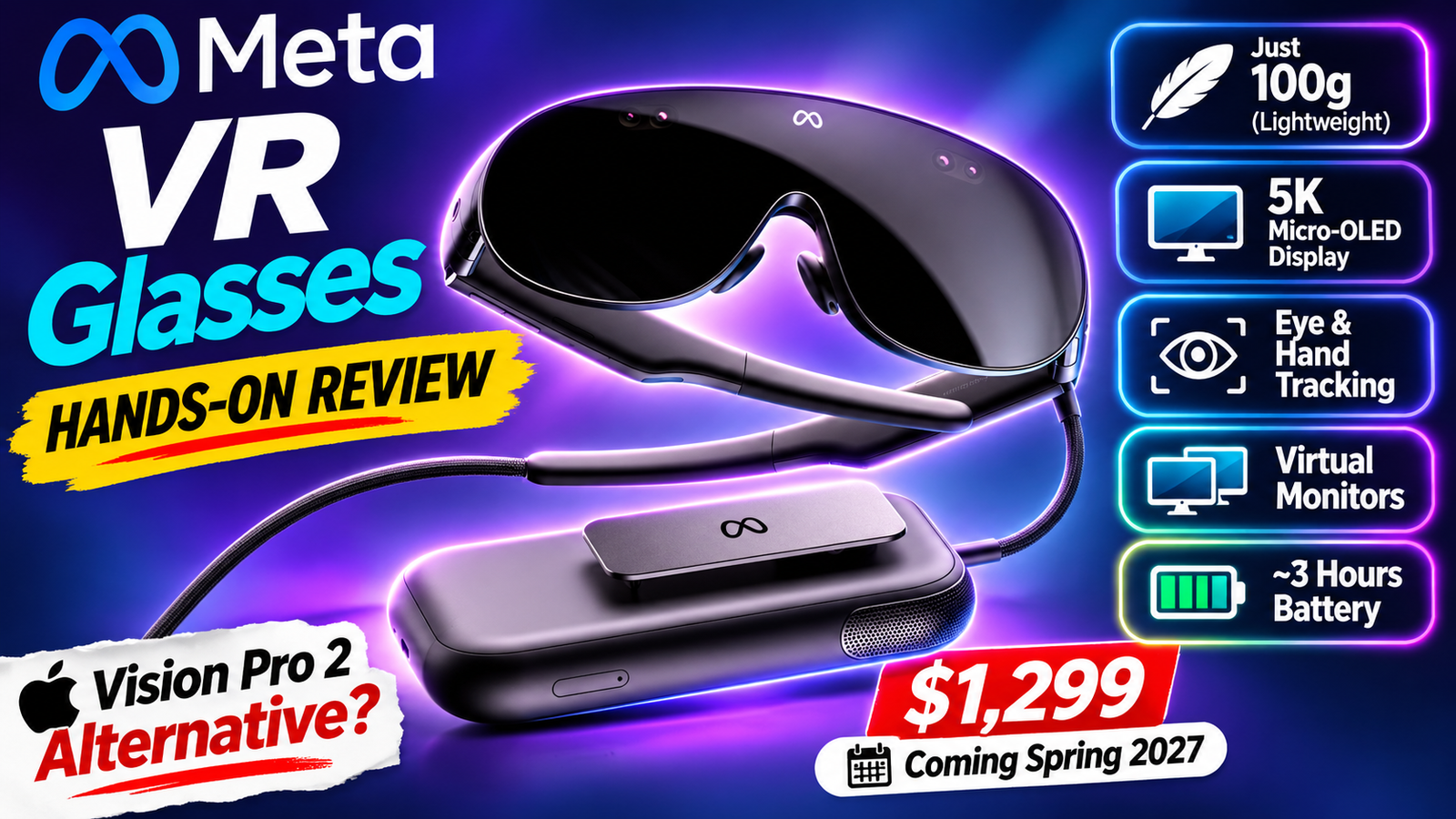
Meta VR Glasses Review: 100g Lightweight Design, 5K Micro-OLED Displays, Features and Price: The future of virtual reality is moving beyond traditional bulky headsets. Technology companies are exploring new ways to make immersive digital experiences more comfortable, portable, and practical for everyday use. Meta is taking an interesting step in this direction with its new Meta VR Glasses, a device that combines a lightweight glasses-style design with the computing power of a traditional VR headset.
Unveiled at Meta Connect 2026, the new Meta VR Glasses introduce a different approach to extended reality (XR). Instead of placing all the hardware inside a heavy headset, Meta separates the display system from the main computing components. The glasses connect to an external computing puck that handles processing, storage, and power.
The result is a device with an approximately 100-gram glasses design, high-resolution Micro-OLED displays, eye tracking, hand tracking, and virtual workspace capabilities.
With a starting price of around $1,300 and an expected Spring 2027 release, Meta is targeting users who want a premium virtual reality experience without wearing a conventional bulky headset.
But can this new design solve some of the biggest problems associated with devices like the Apple Vision Pro and Meta Quest? Here is everything you need to know about Meta VR Glasses, including their design, display, performance, features, and expected price.
1. Meta VR Glasses: A New Approach to Virtual Reality
Meta has been developing different types of wearable technology, including smart glasses and traditional VR headsets.
Its new Meta VR Glasses represent an interesting middle ground between these two product categories.
Unlike conventional smart glasses, these devices do not provide a completely transparent view through ordinary lenses. Instead, they use digital displays and passthrough cameras to show a combination of virtual content and the surrounding environment.
The design features an open-periphery structure that allows some real-world surroundings to remain visible around the displayed image.
This creates a different experience compared with fully enclosed VR headsets.
Meta is positioning the product as a personal entertainment and productivity device that can function as a virtual cinema, gaming system, and multi-monitor workstation.
It is also designed to work with the existing Meta Horizon OS platform, allowing developers to build experiences using familiar tools.
2. Lightweight Design: Just 100 Grams on Your Face
One of the biggest problems with traditional VR headsets is their weight.
Devices such as the Meta Quest 3 and Apple Vision Pro contain several hardware components, including cameras, sensors, processors, batteries, and displays.
Keeping all these components inside a headset makes it difficult to achieve a lightweight design.
Meta takes a different approach by separating the glasses from the main computing hardware.
The glasses themselves weigh approximately 100 grams, making them significantly lighter than conventional VR headsets.
This lightweight construction is made possible through a magnesium alloy frame and a redesigned hardware arrangement.
The glasses contain the optical components, displays, and tracking sensors, while most of the computing hardware is moved into an external puck.
This design could make longer viewing sessions more comfortable.
However, the complete system is not entirely wireless because the glasses remain connected to the computing puck through a cable.
The puck itself weighs approximately 300 grams, so users still need to carry additional hardware.
3. External Compute Puck: The Technology Behind the Glasses
The external computing puck is one of the most important parts of Meta’s new design.
Rather than placing the processor, storage, and battery inside the glasses, Meta moves these components into a separate unit.
The puck contains Qualcomm’s Snapdragon Reality Elite platform, 12GB of RAM, and 128GB of internal storage.
It also includes a microSD card slot, providing additional storage flexibility.
A thin optical tether connects the puck to the glasses, carrying the required data and power.
This arrangement offers several advantages.
First, removing major computing components from the glasses helps reduce their weight.
Second, the external hardware provides more room for processing and thermal management.
Third, separating the components could make the glasses themselves easier to wear for extended periods.
The puck is designed to be carried using its clip, allowing users to attach it to a pocket or bag.
However, the additional cable and external hardware mean this is not the same as using a completely standalone wireless headset.
4. 5K Micro-OLED Display: High Resolution and Smooth Visuals
Display quality is one of the biggest selling points of Meta VR Glasses.
The device features two Micro-OLED displays, one for each eye.
Each display offers a resolution of 2,412 × 2,288 pixels, delivering a combined experience that Meta markets as its 5K Infinite Display.
The displays also support refresh rates of up to 120Hz.
This combination is designed to deliver sharp images, smooth movement, and improved visual clarity.
Micro-OLED technology is particularly useful in compact XR devices because it can deliver high pixel density in relatively small display panels.
The displays also support HDR formats, including Dolby Vision.
For entertainment, this could make the device particularly attractive for watching movies, streaming content, and enjoying immersive visual experiences.
However, resolution is only one part of the overall viewing experience. The field of view also plays an important role.
5. Field of View: A Compromise for a Smaller Design
Although Meta has significantly reduced the size and weight of its new device, the design comes with an important compromise.
Meta VR Glasses offer a field of view of approximately 70 degrees horizontally and 66 degrees vertically.
Traditional immersive VR headsets can offer a considerably wider field of view.
For example, Meta Quest 3 provides approximately 110 degrees horizontally and 96 degrees vertically.
This means users may notice more visible surroundings around the virtual image when using Meta VR Glasses.
The open-periphery design also allows users to remain more aware of their physical environment.
Meta provides optional magnetic light blockers that can reduce outside light entering the viewing area.
These accessories may be particularly useful when watching movies or enjoying content that benefits from a darker environment.
The narrower field of view is an important consideration for anyone expecting the same level of immersion as a traditional full-size VR headset.
6. Eye Tracking and Hand Tracking Without Controllers
Meta VR Glasses are designed around natural interaction rather than requiring users to hold physical controllers for every activity.
The device includes eye tracking and hand tracking.
Eye tracking allows the system to understand where the user is looking, while hand tracking helps recognize gestures.
Users can interact with supported applications by looking at interface elements and performing gestures to select them.
Voice interaction also provides another way to access supported functions.
This approach can make everyday navigation feel more natural.
However, traditional gaming controllers are not completely excluded.
Meta Quest Touch Plus controllers are supported and can be purchased separately.
This provides additional flexibility for users who want to access controller-based games and experiences.
7. Virtual Monitors: A Powerful Productivity Feature
One of the most interesting uses of Meta VR Glasses is virtual desktop productivity.
Imagine carrying a lightweight pair of glasses and using them to create multiple large virtual monitors wherever you go.
Instead of physically transporting several monitors, users can access a private virtual workspace.
This can be useful for professionals who travel frequently, students who need additional screen space, and people who work remotely.
The larger virtual workspace can help users organize different applications and work with multiple windows.
For example, you could keep a browser open on one virtual screen, a document on another, and a communication application on a third.
The actual experience depends on software compatibility and the connected computer.
Nevertheless, virtual monitors could become one of the strongest reasons to consider this device beyond gaming and entertainment.
8. Virtual Keyboard and Trackpad: A Different Typing Experience
Another interesting feature is the ability to turn a physical flat surface into a virtual keyboard and trackpad.
Traditional VR headsets often display floating keyboards that users interact with using hand gestures.
Although this works for simple text entry, typing without physical feedback can be uncomfortable.
Meta’s approach uses a desk or another suitable flat surface.
The system maps a virtual keyboard and trackpad onto that surface, allowing users to interact with them using familiar hand movements.
This creates a more natural typing experience because users can feel the physical surface beneath their fingers.
It could make writing emails, entering information, and working with documents more practical.
This feature demonstrates how XR devices can combine digital interfaces with ordinary physical objects.
9. Gaming and Entertainment Experience
Gaming remains an important part of Meta’s virtual reality ecosystem.
Meta VR Glasses use the same operating system and software platform as Meta Quest devices, giving users access to compatible applications and experiences.
The device is designed to support immersive games, virtual environments, and entertainment applications.
Its Micro-OLED displays and 120Hz refresh rate could provide a smooth visual experience for supported games.
However, the open-periphery design and narrower field of view mean that it is not necessarily the best option for users who want maximum immersion.
Traditional Quest headsets still offer advantages for certain gaming experiences, particularly those that benefit from a wider viewing area.
Meta VR Glasses should therefore be viewed as a combination of entertainment, productivity, and mixed-reality technology rather than simply a gaming headset.
10. How Meta VR Glasses Compare with Apple Vision Pro
The comparison between Meta VR Glasses and Apple Vision Pro is particularly interesting because both companies are approaching spatial computing differently.
Apple Vision Pro uses a traditional enclosed headset design with integrated computing hardware.
Meta, meanwhile, moves much of its computing hardware into an external puck to reduce the weight of the glasses.
The difference is especially noticeable when considering comfort.
Apple Vision Pro offers a highly immersive visual environment, but its traditional headset construction makes it considerably heavier.
Meta VR Glasses focus on reducing the amount of hardware placed directly on the user’s face.
Both devices support eye tracking and hand-based interactions, allowing users to navigate digital environments without relying entirely on physical controllers.
However, their display characteristics and overall experiences are different.
Apple focuses on an enclosed spatial computing experience, while Meta’s open-periphery approach allows users to maintain more awareness of their surroundings.
It is also important to note that Apple has not officially confirmed that Vision Pro development has permanently ended. Reports about its future product strategy should therefore be treated cautiously.
Meta’s new device demonstrates what another generation of lightweight spatial computing hardware could look like.
11. Battery Life and Connectivity
Moving the battery outside the glasses helps reduce the weight placed on the user’s face.
The external compute puck handles power delivery and connects to the glasses through an optical tether.
Meta’s device is designed for portable use, although it still requires users to carry the external computing unit.
The announced battery performance is approximately three hours of media playback, depending on usage conditions.
The system also supports fast charging through a compatible power adapter.
For users planning extended movie sessions or productivity work, battery performance will be an important consideration.
The optical tether is removable at both ends, which also provides some flexibility for cable replacement and servicing.
However, the presence of a cable means users will need to manage the connection while moving around.
12. Meta VR Glasses Price and Release Date
Pricing is one of the most important considerations for this new device.
Meta officially announced its VR Glasses on September 23, 2026, with an expected release window of Spring 2027.
The announced US starting price is approximately $1,299.99.
This places the device in the premium XR category.
At this price, buyers will expect more than basic virtual reality functionality.
The combination of high-resolution Micro-OLED displays, eye tracking, hand tracking, external computing hardware, and productivity features makes the device an interesting option.
However, potential buyers should also consider the additional cost of optional controllers and accessories.
Meta has not yet provided a confirmed global retail price for every country.
International availability, taxes, and local pricing may vary.
Final Verdict: Is Meta VR Glasses Worth Waiting For?
Meta VR Glasses represent an interesting development in the future of virtual reality and spatial computing.
Instead of making another traditional headset, Meta has introduced a lightweight glasses-style design that moves much of the computing hardware into a separate external puck.
This approach addresses one of the biggest problems with conventional VR headsets: the weight and bulk placed directly on the user’s face.
The approximately 100-gram design, 5K Micro-OLED displays, 120Hz refresh rate, eye tracking, hand tracking, and virtual multi-monitor workspace make the device particularly interesting.
However, there are still compromises.
The narrower field of view, external computing puck, connected cable, and approximately three-hour media playback time may not suit everyone.
The $1,299.99 starting price also makes it a significant investment.
For professionals who want a portable virtual workspace, movie enthusiasts interested in a personal cinema, and technology enthusiasts exploring the future of XR, Meta VR Glasses are worth watching.
For users who prioritize fully immersive gaming and a wider field of view, traditional VR headsets may remain a better choice.
Ultimately, Meta’s new device represents an important step toward making spatial computing lighter and more practical. Whether it becomes a mainstream product will depend on its real-world comfort, software support, battery performance, and overall user experience once it reaches consumers in 2027.
Read More: Apple iPad mini 2026 Review: OLED Display, A20 Pro, Price and Features
1 thought on “Meta VR Glasses Review: 5K Display, 100g Design, Features and Price”
Comments are closed.